




Cure
Overview
A Q&A with Karolyn Chamberlin, COO of Rarecells, on the science behind ISET, why whole circulating tumor cells matter for early cancer detection, and the challenge of translating decades of academic research into clinical impact.
Welcome to our Member Spotlight series, where we highlight the groundbreaking work of the companies and individuals in Cure’s community.
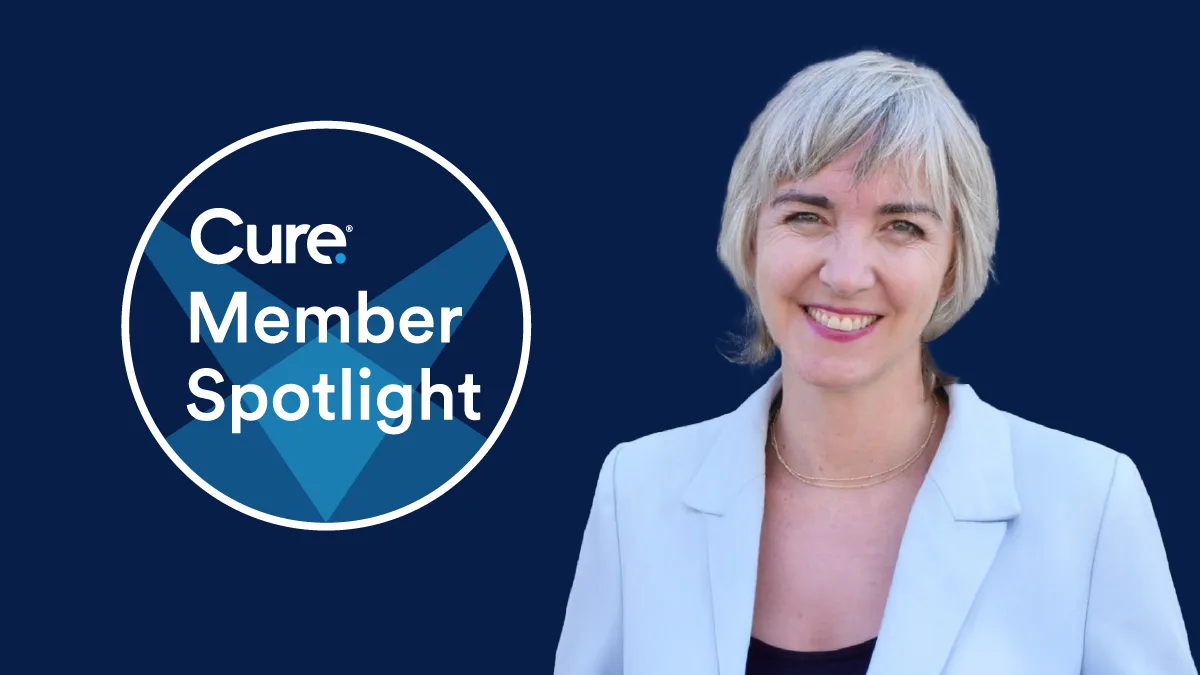
Meet Cure member Karolyn Chamberlin, Chief Operating Officer of Rarecells, a company focused on detecting cancer earlier by capturing intact circulating tumor cells from blood. Built on years of academic research, Rarecells’ ISET platform takes a whole-cell approach to liquid biopsy, offering a different path to early detection and biological insight.
In this Q&A, Chamberlin discusses what drew her to the company’s science-first mission, where fragment-based liquid biopsies fall short, and what it takes to translate rigorous research into clinical practice.
Rarecells was built on years of academic work long before it became a company. What made you want to join them?
I was drawn to Rarecells because of its deeply science-driven culture and the strength of the academic work behind the ISET platform. That rigor really stood out to me, especially in a field where early-stage cancer detection remains such a challenge.
After losing my mom to advanced-stage cancer, I discovered that, despite all our scientific progress, cancer is still usually detected only once it is too late. I am excited to help translate Rarecells strong scientific foundation into real impact on the lives of patients and their loved ones.
For people who’ve never heard of ISET, how do you explain it in simple terms?
ISET (Isolation by SizE of Tumor cell) is a technology that captures whole circulating tumor cells in the blood. Because circulating tumor cells can appear in the bloodstream very early in cancer—sometimes before a tumor is visible on imaging—this approach is especially powerful for early detection and deeper analysis.
Circulating Tumor Cells (CTCs) have been studied for a long time, but the field still feels early. What do you think has held it back?
CTCs are very rare, but ISET can detect a single tumor cell from among 50 billion blood cells in a standard collection tube.
CTCs are also challenging to work with because blood is a complex fluid that naturally coagulates, which makes it difficult to reliably capture rare tumor cells. A big advance for scalability is that ISET works with stabilized blood, allowing processing up to 72 hours after the draw.
In addition, earlier methods relied on specific biomarkers, so they could miss CTCs that don’t express those markers—especially in early-stage disease. Our approach is different because it captures intact CTCs based on size, making it unbiased and more consistent.
Early detection is crowded right now, with a lot of hype around liquid biopsies. Where does Rarecells fit into that landscape?
Liquid biopsy has made exciting advances in recent years, particularly with ctDNA-based approaches, demonstrating that cancer can be detected from a simple blood draw. However, ctDNA is released by tumor cells dying inside the tumor mass and is often barely present in early-stage disease when tumor cells do not die—making detection challenging precisely when cancer is easiest to treat. Rarecells complements these advances by focusing on circulating tumor cells (CTCs)—intact cancer cells that migrate into the bloodstream from the earliest stages of tumor development.
By analyzing tumor DNA from CTCs (CTC-DNA), rather than ctDNA fragments alone, Rarecells can detect early-stage cancer, when ctDNA is often absent. Preliminary data from our ongoing study demonstrates 94% sensitivity in early-stage lung cancer when CTC-DNA is combined with ctDNA (compared to 61% sensitivity for ctDNA alone). Whole cells also provide a more complete view of the tumor, including cellular structure and behavior. At the molecular level, CTC-DNA, especially when combined with ctDNA, captures a broader set of genetic alterations, enabling not only earlier detection but also deeper biological insight from a single blood draw.
Turning a patented research invention into something clinicians can use every day is a long road. What’s been the hardest part of that translation for you?
Rarecells took a very deliberate approach early on by commercializing ISET with academic research institutions to prove that the technology truly works. Today, the platform is used by more than 30 academic centers and has been validated in 125 independent studies, demonstrating an average clinical sensitivity of 91% and specificity of 99% across approximately 2,800 patients and 16 cancer types. That foundation allowed us to move into clinical use, and we are already offering our cellular test to patients through our lab in Paris.
The hardest part now is translating that proven clinical model into the U.S., where the regulatory, reimbursement, and care delivery system is fundamentally different. Successfully navigating that transition—while securing the U.S. funding needed to support clinical scale and adoption—is a challenging but exciting next step in our growth.
You’re a science-first company, but you’re also trying to build a business. How do you decide where to focus?
We’re very intentional about focus because we’re a science-first company with a small team. Being disciplined about where we spend time is essential to continuing to deliver impact. Rarecells is fortunate to have experienced advisors and board members—many of whom have built diagnostics companies before—who help us set clear priorities.
In practice, we concentrate on work that directly advances clinical adoption of our cellular platform: generating clinically meaningful data and partnering where our CTC-DNA approach clearly complements existing ctDNA players. With a team of about 20, time is our most limited resource, so we prioritize partners who understand the clinical problem we are solving and have a clear path to impact.
What does customer demand look like right now? Who comes to you first, and what do they ask that you didn’t expect?
Today, our customers are primarily academic and translational research labs. They typically come to us because they want access to intact circulating tumor cells across a wide range of applications. What’s been particularly interesting is the breadth of use cases. Beyond biomarker discovery and genomic profiling, researchers are exploring how CTCs can be used for detection of cancer and its recurrence, as well as prognosis, drug target identification, and live-cell applications such as cell culturing and in-vitro drug testing. That versatility reinforces our view that intact cells enable questions to be investigated that ctDNA alone cannot.
Every company hits a moment when things feel harder than expected. What was that moment for you at Rarecells?
As a researcher and clinician, our founder Patrizia Paterlini, MD, PhD, had long believed that demonstrating the diagnostic power of circulating tumor cells (CTCs) would be the hardest part. The moment that proved more challenging than expected was realizing that, even when CTCs are clearly diagnostically identified by cytopathology, clinical adoption still depends on extensive—and costly—clinical trials.
Bringing what is essentially a “blood Pap test” to market requires not just scientific proof, but the scale of funding needed to meet clinical and regulatory expectations. However, navigating these challenges ultimately reinforced a commitment to building Rarecells on integrity, scientific rigor, and long-term impact.
If you could get one concrete thing tomorrow to accelerate Rarecells—a trial, a partner, a resource—what would it be?
Honestly, it’s all of the above—but if we had to anchor it to one clear priority, it would be securing the funding needed to advance a dual-analyte, AI-powered test that integrates ctDNA and CTC-derived DNA for early-stage cancer detection. That investment would allow us to run the right prospective clinical studies, apply advanced analytics across both analytes, and generate the level of evidence clinicians and regulators expect for adoption.
In parallel, we are actively engaging with ctDNA assay developers who are seeking to improve test performance in early-stage disease, particularly for detecting recurrence—what’s often referred to as minimal residual disease, or MRD. A partnership of this kind would accelerate clinical validation, produce highly actionable data for clinicians, and clearly demonstrate the added value of combining whole-cell–derived tumor DNA with ctDNA in a real-world clinical setting.