





Illustration by Rob Hadley for Cure
Overview
The data, the framework, and the decisions behind the first ranking of U.S. biomedical institutions on translational performance.
The Cure Innovation Index is the first evidence-based ranking of U.S. biomedical research institutions on their capacity to move scientific discoveries from the laboratory into hospitals and pharmacies.
The Index considered a pool of more than 6,000 institutions of higher learning or with biomedical research activity. More than 1,200 met our strict eligibility criteria, including minimum research spending thresholds and sustained biomedical grant funding. From there, the top 303 were ranked based on how effectively they move their research toward real-world impact, using two dozen indicators that together capture the full arc of biomedical translation: from the strength of an institution's scientific foundation and laboratory infrastructure to its track record of turning discoveries into patents, products, and partnerships.
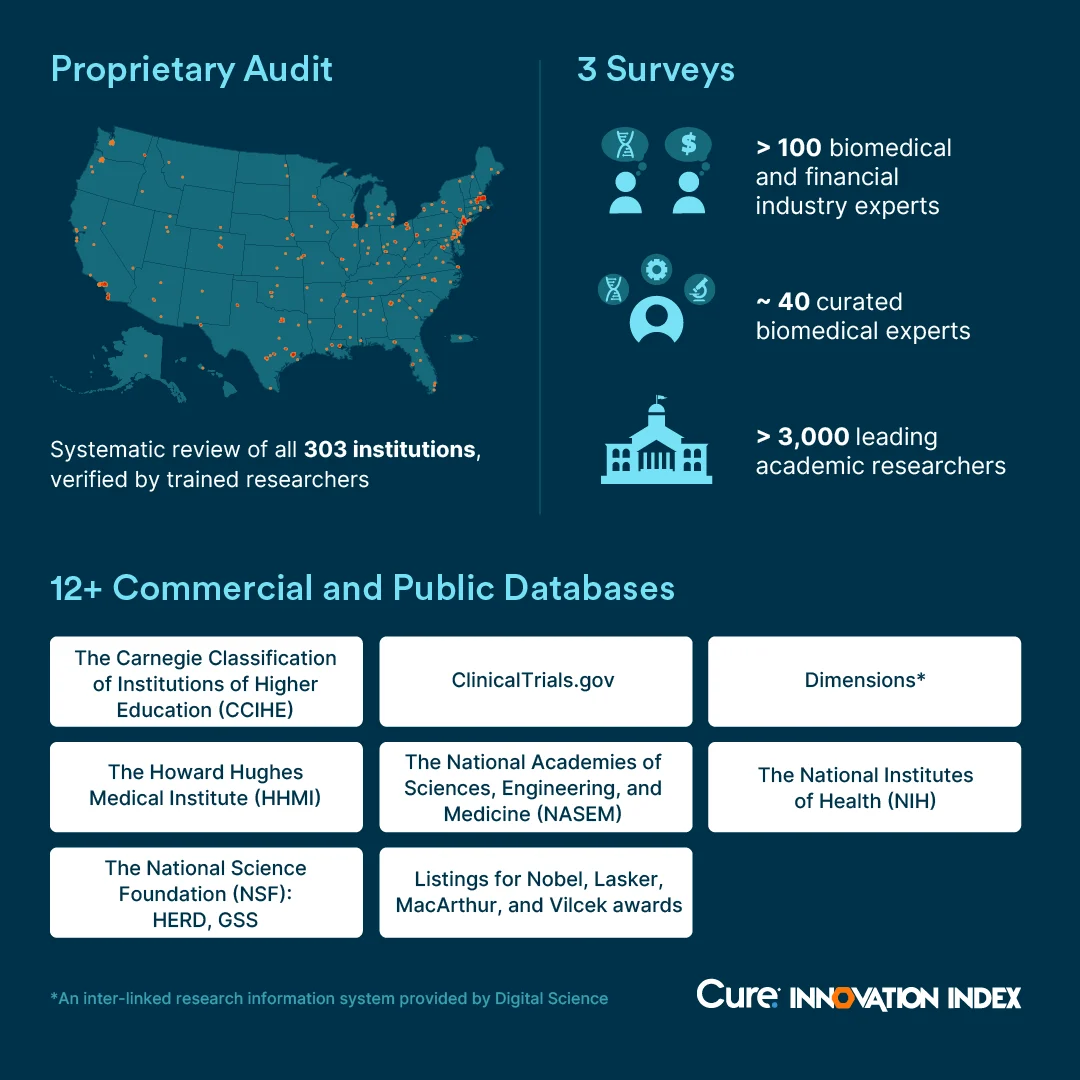
Evaluating these institutions on their translational merit required assembling one of the most comprehensive data sets ever built for this purpose: more than a dozen federal and commercial databases, an original audit of all 303 institutions, and three surveys fielded to more than 3,200 scientists, industry leaders, and biomedical experts.
What follows is an explanation of how we built it.
I. Who's Included
The final ranking includes 303 leading biomedical research institutions, selected from a pool of more than 1,200 eligible candidates from all 50 states, the District of Columbia, and Puerto Rico. Institutions are organized into two broad categories: “Universities” and “Institutes and Centers”. This separation accounts for meaningful differences in how they operate and in the data available to assess them.
Universities were drawn from the Carnegie Classification of Institutions of Higher Education, the nationally recognized framework for categorizing U.S. colleges and universities. Eligible institutions included those classified by Carnegie as R1, R2, and research colleges and universities. In addition, institutions had to be classified as Associate/Baccalaureate (except Professions-focused), Baccalaureate, Undergraduate/Graduate-Master’s, Undergraduate/Graduate-Doctorate, or Special Focus in one of the following categories: Arts and Sciences, Graduate Studies, Medical Schools and Centers, Nursing, Other Health Profession, or Technology, Engineering, and Sciences.
Institutions in this category also had to report R&D expenditures through the National Science Foundation's Higher Education Research and Development (HERD) Survey and meet a minimum funding threshold. Eligible institutions had to average at least $10 million per year over the last three years in R&D spending across six relevant biomedical science fields ("Engineering, bioengineering and biomedical engineering", "Life sciences, biological and biomedical sciences", "Life sciences, health sciences", "Engineering, chemical", "Physical sciences, chemistry", "Physical sciences, materials science”), per HERD FY2021 to FY2023 data.
Institutes and Centers included independent general research hospitals, independent specialty research hospitals, and independent non-clinical biomedical research institutes. To be eligible, institutions in this category had to receive, on average, $10 million or more per year from FY2021 to FY2023 in grant dollars in relevant biomedical science fields.
II. The Analytical Framework
Cure assessed institutions using an analytical framework based on Snowball Metrics, a benchmarking standard developed by research-intensive universities to allow consistent comparisons of research performance across institutions. Snowball Metrics defines a common set of indicators and measurement approaches, which Cure adapted to fit the specific demands of evaluating biomedical translation.
The core research question is: How effectively do institutions translate biomedical research into commercial impact? The result is a composite measure of approximately two dozen indicators, grouped into three primary domains and 10 subdomains of biomedical innovation.
III. What We Measured
1. Research Capabilities
Research Capabilities measures the scientific strength, infrastructure, and funding base that enable institutions to produce high-impact biomedical discoveries. It includes three subdomains:
Facilities and Equipment evaluates whether an institution provides advanced laboratories, core facilities, and shared research technologies needed to conduct cutting-edge biomedical research.
Funding Support evaluates the financial resources available to support biomedical research and innovation activities.
Cutting-Edge Science evaluates the scientific strength of an institution, including the impact and influence of its research output and the recognition of its scientists.
2. Entrepreneurial Readiness
Entrepreneurial Readiness measures how effectively institutions prepare and support researchers to pursue biomedical innovation and commercialization through training, mentorship, and entrepreneurship-focused programs. It includes two subdomains:
Entrepreneurial Ecosystem Support evaluates whether an institution provides formal programs, training, and institutional resources that help researchers translate biomedical discoveries into startups or commercial ventures.
Faculty Engagement evaluates how actively faculty and researchers participate in entrepreneurship and commercialization activities.
3. Market Translation
Market Translation measures how successfully institutions convert scientific discoveries into real-world health innovation through technology transfer, industry collaboration, patents, and translational impact. It includes five subdomains:
Collaborative and Experienced TTO evaluates whether an institution's technology transfer office has the expertise and staff needed to help researchers move discoveries toward commercialization.
TTO Efficiency evaluates how effectively a technology transfer office converts scientific discoveries into commercialization outcomes.
Translational Science and Health Impact evaluates whether an institution's research leads to meaningful health innovations.
Industry Connections evaluates how actively an institution collaborates with private-sector partners.
Industry Reputation evaluates how highly an institution is regarded by industry partners as a place to collaborate on biomedical innovation.
IV. How We Gathered the Data
The Index is a result of extensive original research and data-driven analysis, drawing on more than a dozen federal and commercial databases alongside original data collected directly from institutions and from surveys of academic and industry leaders.
Cure
The Index draws on a wide range of authoritative external sources: Dimensions, an inter-linked research information system provided by Digital Science, which serves as a comprehensive database of research grants, publications, patents, and clinical trials; The Carnegie Classification of Institutions of Higher Education (CCIHE); The Higher Education Research and Development Survey (HERD) and The Survey of Graduate Students and Postdoctorates in Science and Engineering (GSS), administered by The National Science Foundation (NSF); ClinicalTrials.gov, the federal registry of clinical studies; The National Institutes of Health (NIH); The National Academies of Sciences, Engineering, and Medicine (NASEM); The Howard Hughes Medical Institute (HHMI); and major awards listings including Nobel, Lasker, MacArthur, and Vilcek prizes.
For data not available through public sources, Cure collected original data directly from institutions. This included an assessment of core laboratory technology, Technology Transfer Office staffing and policies, and educational curricula, gathered through systematic reviews of institutional websites using automated data collection tools. All results were then audited and verified by a team of trained researchers, each holding a master's degree or higher with prior experience in education or public health research. Auditors verified all data points, using a blended approach of targeted online research, detailed website review, and direct outreach to institutions, where necessary and possible.
In partnership with Deerfield Intelligence, a division of Cure affiliate Deerfield Management, the Index fielded three original surveys that shaped the Index in distinct and substantive ways.
The first surveyed more than 100 leaders from the biomedical and financial industry—venture capitalists, pharmaceutical and biotech executives, and healthcare professionals with direct experience engaging with academic institutions. We asked them a defining question: what qualities or capabilities make an academic research institution particularly strong at supporting health innovation? The themes that emerged from their responses became the foundation of the Index's evaluative structure, its ten subdomains. Respondents were also asked to nominate the institutions they most preferred to collaborate with and the share of nominations an institution received became our measure of industry reputation.
The second surveyed roughly 40 curated experts from the biomedical field, asking them to allocate 100 points across the subdomains within each domain—in effect, to tell us what matters most. Their averaged responses determined the weights that drive our composite scoring, ensuring that the relative importance of each component reflects genuine expert consensus.
The third surveyed more than 3,000 biomedical academic scientists, from full professors to postdoctoral fellows, about how they experience commercialization infrastructure at their own institutions: their familiarity with translational research, their assessment of institutional support, the nature of their industry engagement, and their access to the resources needed to move their work forward.
V. Advisory Board
Led by Cure, the effort to develop The Cure Innovation Index included respected voices from academia, industry, government, and Deerfield Management Company, an affiliate of Cure. Their expertise shapes the integrity of our methodology and ensures the Index reflects the highest standards of scientific rigor. Advisory board members served in a voluntary capacity, contributing their time and expertise out of a shared commitment to advancing translational research.
Irene Abrams - Senior Vice President of Research Innovation, Boston Children’s Hospital
Christine Brideau, PhD - Vice President, Preclinical Pharmacology, 3DC at Deerfield Management
Brian Chow, PhD - Managing Director, Therapeutics at Deerfield Management
Erik Lium, PhD - Chief Commercial Innovation Officer, Mount Sinai Health System
Alicia Loffler, PhD - Executive Director, Kellogg Northwestern Innovation Institute
Lisa Placanica, PhD, CLP - Senior Managing Director, Center for Technology Licensing at Weill Cornell Medicine
Nadim Shohdy, PhD - Chief Operating Officer, 3DC at Deerfield Management