




Cure
Overview
With 27 institutions ranked among the country’s top biomedical innovators, New York’s research cluster spans the entire state, and outperforms nearly every other in the country.
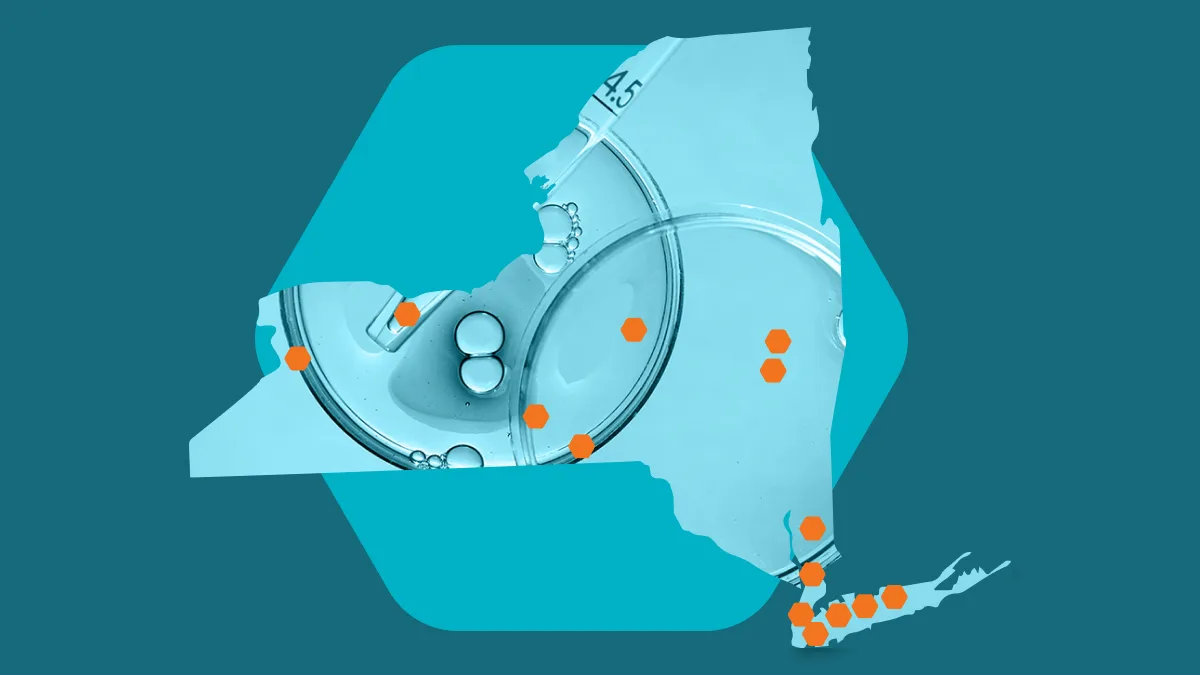
Few states have built a biomedical innovation infrastructure as broad or as deep as New York’s. Decades of strategic investment have produced a research network that ranks among the country’s most prolific in translating science into real-world health impact. The Cure Innovation Index, which ranks the top 303 biomedical research institutions in the country on their translational performance, places 27 New York institutions on the list—seven in the national top 25 and 14 in the top 50 (the latter count trails only California). What makes the state’s standing even more distinctive is how that strength is distributed: research clusters across Buffalo, Long Island, Albany, and the Finger Lakes each carry their own specializations, turning New York into a full-spectrum biomedical operation.
This footprint reflects sustained public and private funding of biomedical research. New York ranks second in the country in National Institutes of Health (NIH) funding at $3.55 billion in 2025, and hosts 3,400 life science companies and 70,000 life science jobs. The state has committed $620 million through its Life Science Initiative, and private capital has followed, including the Chan Zuckerberg Initiative’s investment in CZ Biohub New York, a 2023 research hub pairing New York’s Columbia and Rockefeller Universities with Yale to bioengineer immune cells for early disease detection.
New York’s universities and institutes rank well above the national average, putting the state ahead of peer powerhouses like Texas, which has a comparable research footprint. The Empire State outperforms the national average on all three dimensions the Index measures—research capabilities, entrepreneurial readiness, and market translation—and its institutions are particularly strong on the measure of cutting-edge science, where they score higher relative to the national average than on any other measure.
A Century of Regional Specialization
Four regions of the state carry the bulk of New York’s biomedical footprint: western New York, the Finger Lakes and Southern Tier, Long Island, and the Capital Region. SUNY accounts for six of the institutions outside Manhattan, with research-intensive centers at Buffalo, Stony Brook, and Albany alongside SUNY Upstate Medical in Syracuse, SUNY Downstate in Brooklyn, and Binghamton. Western New York centers around cancer research. Roswell Park and the University at Buffalo anchor a cancer research base that traces back to Roswell Park’s founding in 1898. The University of Rochester, about an hour east, contributes strengths in imaging, vaccine development, and neuroscience.
The Finger Lakes and Southern Tier carry a different kind of cluster, anchored by Cornell University, the second-highest ranked university in the state on the index, behind only Icahn School of Medicine at Mount Sinai. Its Ithaca campus runs research strengths in biomedical engineering, veterinary medicine, nutrition, and cancer biology, and its medical school, Weill Cornell Medicine, operates as a major academic medical center in Manhattan. Binghamton University extends the cluster south.
Long Island holds one of the strongest molecular biology bases in the country. Cold Spring Harbor Laboratory has been a hub for cancer biology, genomics, and neuroscience research since the 1950s, shaping much of what those fields look like today. Stony Brook University, about an hour east, runs a translational research program with roots in the Nobel Prize-winning work on magnetic resonance imaging (MRI) that Paul Lauterbur conducted there in the 1970s. The Feinstein Institutes for Medical Research, in Manhasset, carries the research mission of Northwell Health, the largest healthcare provider in the state.
Albany has emerged as a center for RNA and biotechnology research since the SUNY Albany RNA Institute opened in 2010. The institute received a $50 million state capital investment last year to expand its work in artificial intelligence-driven drug discovery. Rensselaer Polytechnic Institute in Troy contributes engineering-driven biomedical work in biotechnology, regenerative medicine, and medical imaging. Albany Medical College anchors the region’s medical school presence.
Manhattan’s Power Concentration
Still, the highest-ranked New York institutions cluster in Manhattan. Memorial Sloan Kettering Cancer Center, the Icahn School of Medicine at Mount Sinai, Columbia University, New York University, the New York Genome Center, Rockefeller University, and Hospital for Special Surgery each run major translational research programs. NYU Langone, Mount Sinai, and Columbia operate large academic medical centers alongside their research enterprises.
The cluster’s value comes from proximity. A clinical question raised at NYU Langone can move to a Rockefeller bench within an afternoon. Four more institutions across the five boroughs appear further down the list: Albert Einstein College of Medicine in the Bronx, NewYork-Presbyterian Hospital, and two CUNY campuses in Manhattan.
The Cure Innovation Index puts a number on what New York has spent decades building: one of the strongest biomedical innovation ecosystems in the country. Use the Cure Innovation Index interactive map for a full list of New York State’s institutions and their ranks.