



New Cure Innovation Index evidence-based analyses and expert survey find U.S. retains its scientific edge but is losing the race to translate discoveries to cures
NEW YORK, June 22, 2026. — The United States still leads China in the quality and commercial reach of its biomedical science but is losing the race to translate scientific discoveries into cures. New analyses from the Cure Innovation Index, released today ahead of Cure's session on U.S.-China biomedical competitiveness at the BIO International Convention in San Diego, find that without immediate renewed investment and policy changes, the U.S. scientific edge will not hold.
“America’s challenge is no longer discovery alone. The emerging battleground is translation, the speed and efficiency with which scientific breakthroughs move from the laboratory into development, commercialization, and patient impact," said Seema Kumar, CEO of Cure, the premier healthcare innovation ecosystem headquartered in New York City. "If the United States wants to stay ahead, the answer isn't to out-publish China. It's to fix the translational bottlenecks with renewed funding, especially for early translational work, modernized clinical trial infrastructure, and stronger bridges between academic research and industry."
Cure’s new findings stem from five Cure Innovation Index analyses: a survey of U.S. industry and academic leaders, three bibliometric studies of the top 10 biomedical research institutions in each country, and a clinical trial infrastructure and commercial embeddedness analysis across U.S. and Chinese institutions.
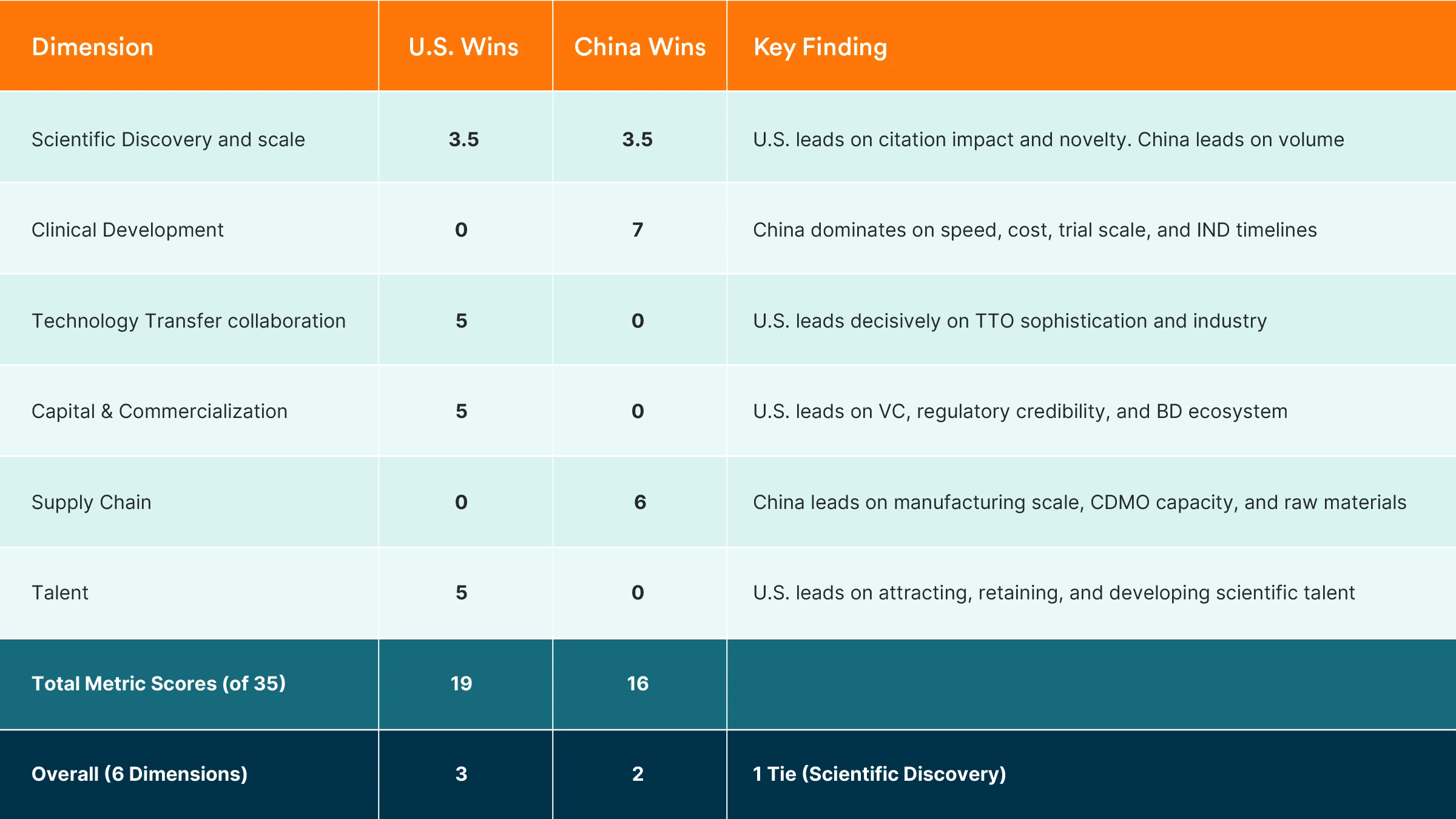
The U.S.-China Biotech Competitiveness Scorecard: Where Each Country Leads
Cure’s survey of senior U.S. industry and academic leaders, fielded in June 2026, shows their perceptions of both the competitive picture and the prescription for maintaining U.S. leadership.
72 percent said China’s biomedical sector is improving faster than the United States’
85 percent said the U.S. lead will last 10 years or less.
74 percent cited declining U.S. federal research funding as the top threat to U.S. biomedical leadership, rather than any single Chinese competitive move.
76 percent expect more R&D to shift outside the United States if current trends continue.
"The experts are telling us the same thing the data are telling us," Kumar said. "We have the science and the commercial ecosystem. What we are missing is the sustained investment in translation, backed by the federal funding that makes that possible. This is not a story about who leads today. It is about who leads in 10 years. Right now, that is an open question, and the U.S. only stays in front if it treats market translation as seriously as it treats discovery."
“America’s scientific leadership and discovery capabilities are our greatest strategic assets. To protect and expand that leadership, we need a coordinated national strategy that strengthens the full innovation continuum, from NIH-funded discovery to translational development, national clinical trial infrastructure, domestic manufacturing, resilient supply chains, and global talent. Discovery alone will not secure leadership; execution, infrastructure, and coordinated investment will,” said Vanessa Almendro Navarro, Ph.D., MBA, Chief Commercial Officer, City of Hope.
Cure asked respondents to assess the two countries across 35 metrics in six dimensions of end-to-end innovation. As reported in the Cure Innovation Index U.S.-China Biotech Competitiveness Scorecard, respondents gave the United States decisive advantages in three dimensions: capital formation and commercialization, technology transfer, and talent. China received decisive leads in two dimensions: clinical development and supply chain infrastructure.
Scientific discovery, the sixth dimension, was effectively viewed as a tie. While the United States continues to lead in several frontier technologies and citation impact, China now matches the U.S. overall in discovery-related capabilities, underscoring how rapidly the competitive landscape has evolved.
“When it comes to saving lives and curing diseases, there should be no competition, only cooperation,” said Alex Zhavoronkov, PhD, CEO, Insilico Medicine. “But if you want to compete with China, it is important to set up local presence and compete with China in China. Without having a very efficient local discovery engine that takes full advantage of the local infrastructure and highly-qualified talent which likes to work only for top companies in the field, it is impossible to compete with the locally-brewed companies.”
Zhavoronkov, whose company recently went public on the Hong Kong Stock Exchange, added “China is the world’s UFC of drug discovery - the ultimate gym where every dollar, every month, every quality metric counts and is used for competitive advantage. If you can win in China - you can win everywhere in the world and you can really win against diseases.”
Which Country Leads? Visit the Cure Innovation Index U.S.-China Biotech Competitiveness Scorecard for complete results.
U.S. Influence Advantage Widening in Frontier Science, Industry Engagement
U.S. and Chinese biomedical research institutions are now operating at comparable publication scale, but the volume does not translate to comparable scientific influence, Cure’s bibliometric analysis found.
U.S. and Chinese institutions now publish at a nearly identical annual per-institution volume (43,562 for U.S. and 43,532 for China), but U.S. institutions generate scientific influence at a rate 31 percent higher than Chinese peers, as measured by the Mean Relative Citation Ratio (RCR), a field- and year-normalized metric developed by the U.S. National Institutes of Health (NIH). The analysis involved an examination of more than 200,000 papers published from the top 10 biomedical research institutions in each country between 2020 and 2024.
“China has effectively closed the biomedical publication scale gap with U.S. elite institutions, a remarkable achievement over the 2020 to 2024 window,” noted Kumar. “However, the scientific influence of U.S. publications persists and widens in frontier biomedical domains that will define next-generation medicine.”
Of the four frontier biomedical domains that Cure examined, U.S. institutions lead China with a 45 percent RCR in CRISPR and gene editing publications, 60 percent RCR in RNA therapeutics, and 90 percent RCR in CAR-T and cell therapy. For AI drug discovery publications, the U.S. leads with a 52 percent RCR, yet China leads in volume, which is the closest competitive volume gap of the four domains and reflective of China’s building of AI research capacity.
"AI doesn't favor incumbents. It favors whoever deploys it fastest. China is moving with speed and intentionality. The U.S. has stronger foundational science — but whether that translates into a sustained lead depends on how quickly its institutions modernize around it,” said Jue Wang, PhD, Vice President and Global Head of Business Development, Insilico Medicine. “The real question isn't whether AI will reshape global biotech leadership. It's whether science and industry can move fast enough together to realize that potential and unlock its full potential for patients.”
Cure's separate industrial engagement analysis directly measured the extent to which academic research is embedded in commercial development. It examined the volume of papers from 2020 to 2025 by the same top 20 institutions that had industry-based co-authors. U.S. institutions were nearly three times more commercially connected than their Chinese counterparts, with respective rates of 9.0 percent vs. 3.3 percent co-authorship. This structural gap has remained stable for six consecutive years despite China's rapid publication scale-up.
The Translation Gap: Clinical Trials Are Already Migrating Away from the U.S.
The Cure Innovation Index’s starkest finding, China's 7-to-0 advantage on clinical development metrics, reflects the speed and scale of China's clinical development advantage. A Cure Innovation Index analysis of U.S. clinical trial infrastructure helps explain the domestic side of this gap.
Among U.S. research universities tracked by the Index, institutions affiliated with the NIH's Clinical and Translational Science Award (CTSA) network run a median of 64 Phase 1 and Phase 2 trials annually. The median non-CTSA university runs just one. That 64-to-1 ratio captures the translational bottleneck in a single number, Kumar noted.
A new publication from the Reagan-Udall Foundation for the FDA, with which Cure has no affiliation, reports outcomes of a March 2026 early-stage drug development roundtable supported by BIO, provides corroborating data:
China's share of global clinical trial starts has grown from 1 percent in 2009 to 32 percent in 2025, nearly matching the United States' 35 percent share.
Early discovery-to-IND cycles in China are estimated to be 50 to 70 percent faster than in the rest of the world.
Phase 1 trials cost an estimated 50 to 60 percent less in China.
Chinese biopharmaceutical companies now account for about one-third of new compounds entering the U.S. pipeline.
“The next era of biopharma innovation will not be defined by geography, but by the ability to combine the best capabilities across ecosystems,” said Yan Ling, PhD, Executive Director, Head of Research Innovation China, Takeda. “The U.S. brings science, capital, regulatory credibility, commercialization, with global access. China brings speed, scale, clinical execution, manufacturing depth, and a growing innovation pipeline. Linking these strengths across discovery, translation, development, and manufacturing can build more resilient pathways and accelerate innovative medicines to patients.”
What Leaders Say Needs to Happen
The Cure survey and analyses reveal the most urgent levers for maintaining U.S. biomedical leadership: protect discovery, accelerate translation, and strengthen competitiveness. As stated in the Reagan-Udall Foundation report, "without deliberate investment and direction, the U.S. will continue to lose Phase 1 programs to countries that have made precisely that investment."
Protecting discovery requires restoring NIH and federal research funding, which 81 percent of Cure survey respondents identified as the single highest policy priority. Moreover, 61 percent called for expanding translational funding programs specifically.
Accelerating translation means expanding dedicated translational funding programs and modernizing U.S. clinical trial infrastructure to bring the speed, cost efficiency, and patient access that have allowed China to claim 32 percent of global trial starts in less than two decades.
Strengthening competitiveness over the long term requires rebuilding domestic biomanufacturing and supply chain capacity and enacting policies that attract and retain the scientific talent on which U.S. leadership ultimately depends. Fifty-two percent of the survey respondents ranked improving talent and immigration policies as second only to funding priorities. Modernizing clinical trial infrastructure was a priority for 50 percent of respondents, with strong support from industry respondents (62 percent).
"The data make clear that the United States has a real and durable scientific edge. But that edge is not self-sustaining," said Kumar. "We are not losing because China has better science. We are losing because we have underinvested in the infrastructure that moves science into medicine. Restoring that investment is not just a research priority. It is a national security and economic imperative. The window to act is open, but it will not stay open."
About the Cure Survey Methodology
Cure fielded the U.S.-China Biotech Competitiveness Survey fielded from June 11 to 17, 2026, to senior leaders in biomedical industries and U.S. academic research. The 117 respondents split nearly evenly between industry (61) and academia (54) including chief executive officers, founders, chief scientific officers, business development directors, and technology transfer leaders.
BIO Session: Racing to Cures: the U.S.-China Biomedical Competitiveness Scorecard
June 22, 2026, 4:15 PM - 5:15 PM PDT, Room 30DE
The United States has long assumed global leadership in biomedical innovation. How will it continue to retain its edge? China has dramatically accelerated its research output, clinical trial volume, and pharmaceutical pipeline, producing raw materials, creating drug discovery platforms, and commercializing world-class therapies while competing head- to-head in licensing and BD. Drawing on the Cure Innovation Index and a new survey of U.S. academics and industry leaders, moderator Seema Kumar will debut a U.S./China innovation scorecard to reveal the strengths, opportunities, and strategies driving stakeholders in each country's end-to-end innovation engine. Bringing together voices from industry, government, and academia, this session delivers data, debate, and actionable insights for institutions, investors, and industry to stay competitive.
Moderator: Seema Kumar, CEO, Cure
Panelists:
Vanessa Almendro Navarro, PhD, Chief Commercial Officer, City of Hope
Yan Ling, PhD, Executive Director, Head of Research Innovation China, Takeda Pharmaceuticals
Jue Wang, PhD, Vice President and Global Head of Business Development, Insilico Medicine
About the Cure Innovation Index
The Cure Innovation Index is the first data-driven framework to measure how effectively U.S. biomedical institutions translate scientific discovery into real-world healthcare solutions and treatments.
Launched in April 2026, the Index sets a new standard for measuring translational performance that reflects its real and potential positive impact on patients, the healthcare system, and the broader economy. Unlike traditional metrics, which focus on individual outputs, the Index evaluates the full set of factors required to move innovation from discovery to early research to clinical and commercial impact.
The Cure Innovation Index is built on a proprietary methodology that evaluates 25 indicators across three core domains: Research Capabilities, Entrepreneurial Readiness, and Market Translation. Together, these domains capture the structural, operational, and cultural factors that enable institutions to convert scientific breakthroughs consistently and reliably into therapies, companies, and measurable health impacts.
The Index ranks the top 303 academic institutions, selected from more than 6,000 nationwide, and represents all 50 states, the District of Columbia, and Puerto Rico. The Index also provides peer-benchmarked comparisons and customized improvement recommendations, making translational performance visible, comparable, and actionable.
About Cure
Cure is the premier healthcare innovation ecosystem that provides knowledge, infrastructure, and tools to accelerate progress toward cures. Headquartered in New York City, Cure convenes all key stakeholders for innovation across its physical and digital community. The campus houses flagship event venues and is home to healthcare organizations from idea stage to public companies. Cure members gain access to premium opportunities and curated connections. In 2026, The Cure Innovation Index was published, providing unmatched visibility into how research institutions translate breakthrough science into real-world health impact. Innovate with Cure at wewillcure.com.
Cure Media Contact: index@cureexperience.com