



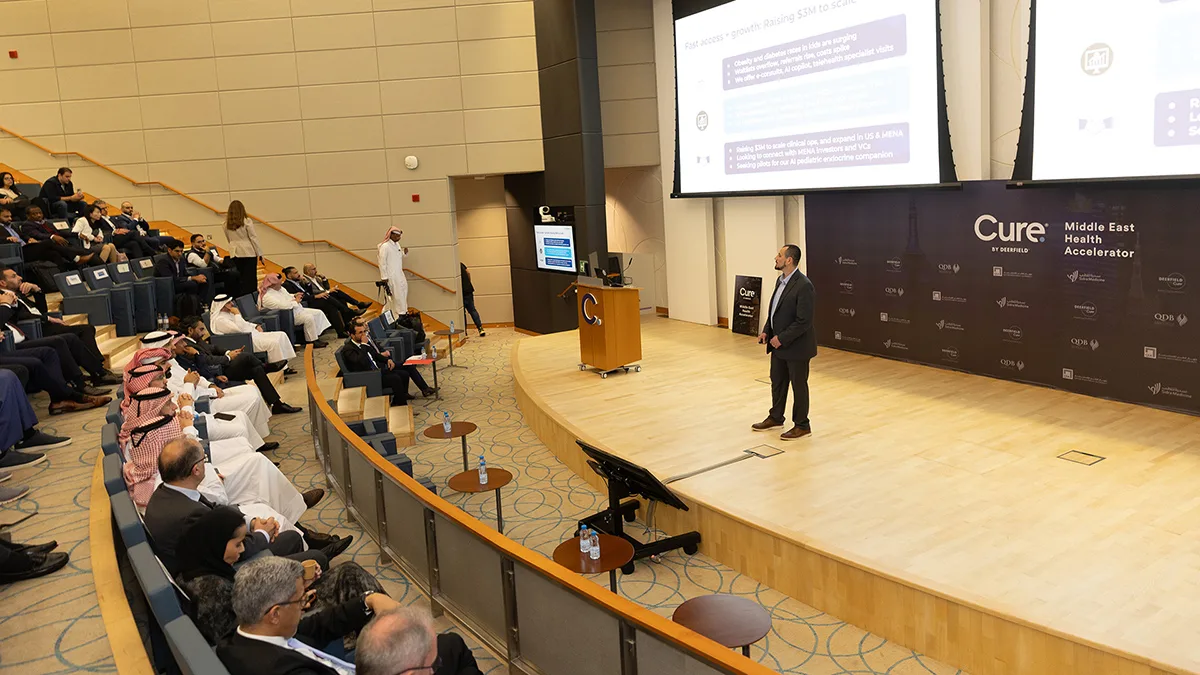
Dr. Karim Ginena of EndoMD presenting at MEHA Demo Day in Qatar in January 2026. Photo: Cure.
Overview
The startup is using insights from the Cure by Deerfield Middle East Health Accelerator to refine its care model and expand access to pediatric endocrinology across new markets.
EndoMD Health is a Virginia-based digital-first endocrinology platform that delivers in-network care for children and young adults with metabolic conditions. Co-founded by Karim Ginena, PhD, the company aims to reduce the long wait times many families face by offering telehealth services.
The company’s innovative approach and compelling pitch earned EndoMD third place at the Cure by Deerfield Middle East Health Accelerator’s Demo Day, where 13 cohort companies presented to a judging panel of regional healthcare, investment, and policy stakeholders, along with approximately 150 audience members.
In an exclusive interview with Cure, Ginena shared how EndoMD is accelerating care for families, expanding through pilots and partnerships, and learning from the lessons he took away from Demo Day in Qatar.
Tackling Pediatric Endocrinology Challenges
To understand the mission behind EndoMD, it helps to look at the challenges in pediatric endocrinology. There are major access and coordination gaps, especially for conditions like obesity, prediabetes, diabetes, and other hormone-related concerns, and delays can worsen symptoms. “In many markets, families wait months to see a pediatric endocrinologist,” said Ginena.
During this waiting period, a child’s condition may progress, parents often feel anxious, and primary care clinicians may lack fast access to specialist guidance. At the same time, specialists are overwhelmed with referrals, many of which are incomplete, missing labs, or could have been managed earlier with the right support.
As the EndoMD team examined the bottlenecks more closely, they realized the challenge was far more complex than a simple specialist shortage. Factors such as fragmented referral processes, poor data quality at intake, limited reimbursement models for early specialist guidance, and minimal infrastructure for coordinated care among PCPs, specialists, and families all contribute to delays.
In response, EndoMD has developed tools that help structure and summarize referrals, surface missing information, and support triage/workup decisions for clinician review. “The goal is not to replace the pediatric endocrinologist, but rather to reduce administrative friction, improve referral quality, and help specialists practice at the top of their license,” explained Ginena.
What sets EndoMD apart is that it is not just a telehealth clinic offering Zoom visits.“We are building a pediatric endocrine care model that combines specialist access, workflow redesign, and technology to improve how care is triaged, delivered, and followed through,” Ginena explained. The company’s main focus is getting the right child to the right level of care faster, whether it be through virtual specialist visits, asynchronous specialist guidance for referring clinicians, or clearer workup pathways so families and PCPs are not stuck waiting without a plan.
Demo Day in Qatar: Showcasing a Scalable Model
Pitching at Demo Day in Qatar was a pivotal experience for the EndoMD team. “It was exciting, high-stakes, and deeply validating because we were presenting a mission-driven healthcare company in front of a sophisticated audience that included investors, healthcare leaders, and ecosystem stakeholders who understand both the urgency of chronic disease and the opportunity for innovation,” Ginena described.
Rather than presenting EndoMD solely as a U.S.-based company, Ginena positioned it as a scalable model for improving pediatric chronic care access in systems facing specialist shortages and rising metabolic disease burdens. That framing felt particularly relevant in Qatar and the broader Middle East region, where childhood metabolic disease is a growing concern. For example, roughly 50% of school-age children in Qatar are affected by obesity.
Demo Day also sharpened how Ginena tells the EndoMD story. A major takeaway was that global partners and investors respond well when the story is both clinically credible and operationally specific. “They want to know not only why the problem matters, but how the model works in practice and what success metrics you will prove next,” he explained.
Building the Future of Pediatric Endocrinology
Looking ahead, the next phase for EndoMD is two-part. Ginena wants to both validate the care model through pilots and partnerships and build the infrastructure for responsible multi-market growth. “Together, these milestones position EndoMD to move from a high-growth early-stage company into a scalable pediatric specialty care platform with real system-level impact,” said Ginena.
Measurable outcomes for pilots and partnerships include key metrics such as faster time to specialist input, improved referral quality, fewer unnecessary in-person referrals, and higher follow-up completion rates. In building the infrastructure that supports multi-market growth, the EndoMD team aims to establish stronger payer/reimbursement pathways, deploy technology to improve triage and referral workflows, and operational systems to expand responsibly while maintaining clinical quality.