




Cure
Overview
A look at 11 companies using AI-driven platforms to reshape drug discovery, including generative models, computational chemistry, and data-centric biology.
Artificial intelligence is changing the landscape of drug discovery at lightning speeds. It has taken what was once a long, tedious, and labor-intensive process and turned it into a faster, more data-driven endeavor that is not only cutting years off research time but is also helping researchers discover promising new ways to treat everything from rare diseases and cancers to immunological issues and skin diseases.
“AI is having a tremendously positive impact on drug discovery by accelerating drug screening, generating predictive outcomes, and optimizing the chemistry of new treatments, leading to faster, more cost-effective development cycles,” said Carter Caldwell, MBA, an entrepreneur, investor, and the Penn Medicine Co-Investment Program Director at the University of Pennsylvania. “One notable application is the use of AI to identify new therapeutic targets for existing FDA-approved drugs. This approach has already yielded promising results.”
Contrary to popular belief, Caldwell said scientists are not being replaced by AI. Instead, he said, the new technology is empowering those scientists to accelerate and enhance the drug discovery lifecycle at far lower costs. In fact, a recent study found that AI adoption among researchers has surged from 57% to 84% in just one year.
“It’s too early to tell, but the historically time-consuming and costly, start-stop, and trial-and-error process of drug discovery is already evolving and dramatically reducing the bench-to-beside time and increasing success rates,” said Caldwell.
AI allows scientists to move through large volumes of content more quickly and efficiently, explained Josh Jarrett, MBA, the Senior Vice President of AI Growth at Wiley, a global research and publishing provider. “There's vast amounts of information out there and there's more getting created every day. The human workload [is immense] when you're generating a hypothesis to go and do the literature search, to go and look for what other studies have been done, and to look across different disciplines. So AI is making the process more efficient—it’s just the brute power of being able to have the machine do a lot of the reading, processing, pattern matching, and summarization that you needed an army of research assistants to be able to do.”
AI also allows researchers to unlock new insights and innovation by looking at cross discipline connections that they couldn't have looked at before, said Jarrett, whose company just launched an artificial intelligence platform to give researchers quick and effective access to peer-reviewed papers and articles from scholarly publications. “They can identify patterns in the data that would be very difficult if they were looking at a smaller scale to identify. Some people are predicting a 50% reduction in drug development timelines.”
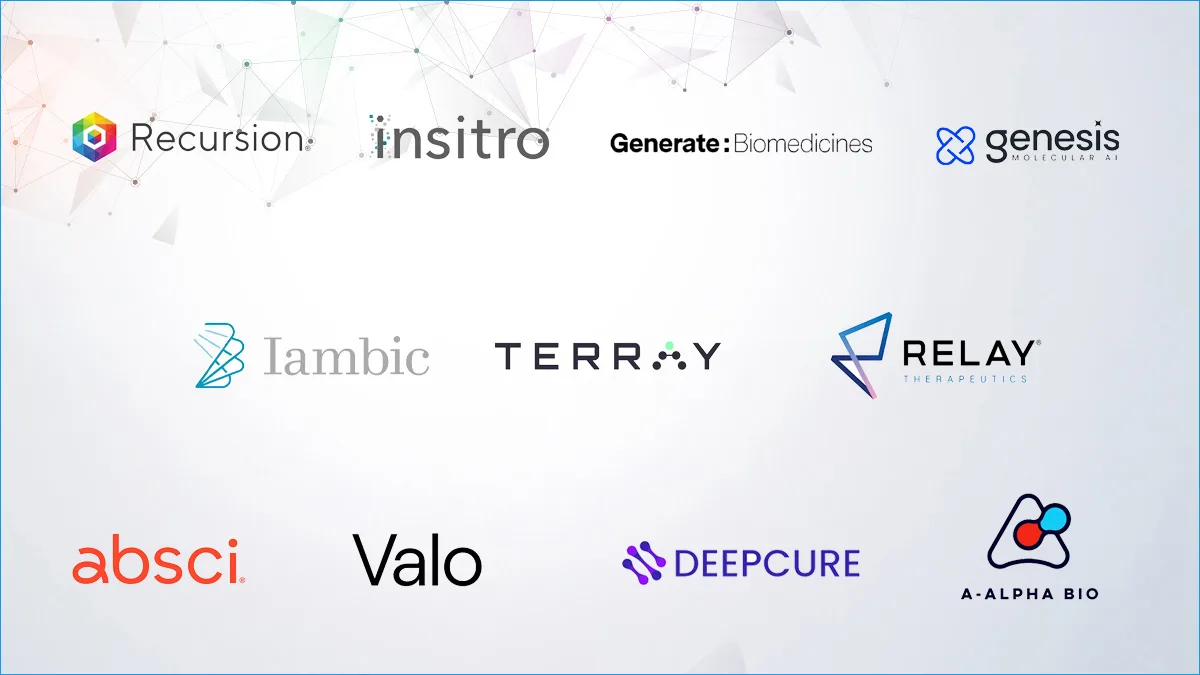
In this article, we highlight companies at the forefront of these cutting-edge efforts. Whether it’s a distinctive technological edge, unique generative AI models, proprietary computational tools, or multi-faceted biological data integration, these organizations are redefining how important medicines are discovered and delivered to people in need.


Recursion Pharmaceuticals

HQ: Salt Lake City, Utah
Year Founded: 2013
Key Leaders: Najat Khan, PhD, Chief R&D Officer, Chief Commercial Officer, and incoming CEO; Chris Gibson, PhD, Chairman and Former CEO; David Hallett, PhD, Chief Scientific Officer; David Mauro, MD, PhD, Chief Medical Officer; Ben Mabey, MS, Chief Technology Officer; Kristen Rushton, MBA, Chief Operations Officer
Number of Employees: ~ 800
Stage: Clinical Notable Investors: Lux Capital, DCVC, Baillie Gifford, Leaps by Bayer
Key Products: As a founding member of BioHive, the Utah life sciences industry collective, Recursion is building a pipeline of therapeutic assets in oncology and rare diseases. Therapeutic partners include Bayer, Roche/Genentech, Merck, and Sanofi.
Recent Highlights: In April 2025, the first patient was dosed in the Phase 1 EXCELERIZE clinical study evaluating REC-3565 for the treatment of relapsed or refractory B-cell lymphomas. That same year, they also acquired Rallybio’s (NASDAQ: RLYB) full interest in their joint ENPP1 inhibitor program (REV102) and an associated backup molecule for the treatment of hypophosphatasia (HPP), a rare and debilitating genetic disorder.
Insitro

HQ: San Francisco, CA
Year Founded: 2018
Key Leaders: Daphne Koller, PhD, Founder and CEO; Ajamete “AJ” Kaykas, PhD, Chief eXploration Officer and Head of Neuroscience; Mary Rozenman, PhD, CFO and CBO; Philip Tagari, MA, Chief Scientific Officer; S. Michael Rothenberg, MD-PhD, Chief Medical Officer
Number of Employees: ~230
Stage: $400M Series C in March 2021
Notable Investors: Andreessen Horowitz, Arch Venture Partners, Black Rock, Casdin Capital, CPP Investments, Foresite Capital, Soft Bank, Temasek, Third Rock, T. Rowe Price, Two Sigma Ventures, GV
Key Products: The pipeline for Insitro consists of advanced research into metabolic pathologies including metabolism and obesity, as well as neurodegenerative conditions such as ALS.
Recent Highlights: In 2025, the company described COAST-SS, a new framework for identifying genes that exhibit dose–response relationships, in the The American Journal of Human Genetics. According to the researchers, COAST-SS builds on the company’s earlier work and offers a major step forward in scalability. In 2025, they also partnered with INSIGHT Eye Hub in London, the world’s largest eye imaging bioresource containing 35 million eye images. This partnership will help further their research in neurodegenerative disease and related conditions.
Generate Biomedicines
HQ: Cambridge, MA
Year Founded: 2018
Key Leaders: Michael Nally, MBA, CEO; Molly Gibson, PhD, Co-Founder; Gevorg Grigoryan, PhD, Co-Founder and CTO; Laurie Lee, MD, Chief Medical Officer, Immunology & Inflammation; Jason Silvers, JD, CFO
Number of Employees: ~300
Stage: Founded and backed by Flagship Pioneering, now operating as independent clinical-stage biotech.
Pipeline: Generate Biomedicines’ pipeline includes therapeutics in immunology, oncology, and infectious diseases. They also have several undisclosed projects underway with Amgen and Novartis.
Recent Highlights: In September 2025, Generate shared the results of its Phase 1 study of GB-0895 at the European Respiratory Society International Congress in Amsterdam. GB-0895 is an investigational anti–thymic stromal lymphopoietin (TSLP) antibody, which had promising results. Early findings highlighted encouraging safety and biological activity signals, supporting continued clinical development in respiratory disease. Experts indicate GB-0895 could provide a treatment alternative for people with respiratory diseases, including severe asthma.
Genesis Therapeutics
HQ: Burlingame, CA
Year Founded: 2019 (received seed funding)
Key Leaders: Evan Feinberg, PhD, CEO and Co-Founder; Will McCarthy, MBA, COO; Shifeng Pan, PhD, CSO Number of Employees: ~150
Stage: Completed a $200 million Series B in 2023, led by a16z Bio + Health
Notable Investors: a16z Bio + Health, Rock Springs Capital, NVentures, Radical Ventures, Menlo Ventures
Key Pipeline: The Genesis pipeline is focused on generating and optimizing small molecules for challenging biological targets to address the treatment of difficult cancers. Their partners include Incyte and Gilead.
Recent Highlights: In October 2025, Genesis unveiled Pearl, a generative foundation model that predicts drug-protein Structure. They also shared a study demonstrating this new AI model beats AlphaFold 3 in successfully predicting how small molecules bind to proteins.
Iambic Therapeutics
HQ: San Francisco, CA
Year founded: 2020
Key Leaders: Tom Miller, PhD, Co-Founder and CEO; Fred Manby, PhD, Co-Founder and CTO; Neil Josephson, MD, Chief Medical Officer; Pete Olson, PhD, Chief Scientific Officer; Michael Secora, PhD, CFO and Chief Corporate Development Officer
Number of Employees: ~120
Stage: Clinical stage life science and technology company
Notable Investors: Abingworth, Alexandria Venture Investments, Alumni Ventures, ARK, Ascenta, Catalio, Everbright Biofund, Freeflow Ventures, Illumina Ventures, Mubadala, Pegasus Tech Ventures, Qatar Investment Authority, Regeneron Ventures, Sequoia, Tao Capital Partners, Terra Magnum Capital Partners, Wilson Sonsini Goodrich & Rosati, and others.
Pipeline: Within the Iambic pipeline, they are working on several drugs. Most notably, their work with IAM1363, an irreversible tyrosine kinase inhibitor (TKI) that selectively targets HER2 and HER2 mutants, is in Phase 1. Patient dosing started in March 2024 within a multi-center trial.
Recent Highlights: In November 2025, Iambic raised over $100 million in an oversubscribed financing round. This funding was provided by new and existing investors. They also announced a research collaboration with Jazz Pharmaceuticals to evaluate combination therapy with Zanidatamab with IAM1363 in patients with HER2-positive breast cancer. Iambic is also collaborating with Revolution Medicines.
Terray Therapeutics
HQ: Monrovia, CA
Year Founded: 2018
Key Leaders: Jacob Berlin, PhD, CEO; Vanessa Taylor, PhD, Chief Scientific Officer; Fez Ujjainwalla, PhD, Chief Business Officer; Eli Berlin, Chief Financial and Operating Officer; Narbe Mardirossian, PhD, Chief Technology Officer; Craig Schulz, PhD, Chief Platform Officer
Number of Employees: ~130
Stage: Completed series B funding of $120 million in 2024
Notable Investors: Bedford Ridge Capital, NVentures (NVIDIA’s venture capital arm), Maverick Capital, Goldcrest Capital, Madrona Ventures, Two Sigma Ventures, XTX Ventures, Digitalis Ventures, and Alexandria Ventures
Key Products: Terray’s internal pipeline is focused on immunology (which includes a co-development program with Odyssey Therapeutics). It also is in discovery partnerships with Calico, Bristol Myers Squibb, and Gilead.
Recent Highlights: In November 2025, Terray introduced EMMI, their “chemistry-first, AI-native small molecule drug discovery platform.” The company says EMMI, which is focused on small molecule drug discovery and development using computation integrated with novel data, has delivered structurally novel molecules to address targets across Terray’s diverse pipeline.
Relay Therapeutics
HQ: Cambridge, MA
Year Founded: 2016
Key Leaders: Sanjiv Patel, MD, President and CEO; Don Bergstrom, MD, President, R&D; Imogen Price, PhD, COO, R&D; Pete Rahmer, Chief Corporate Development Officer; Tom Catinazzo, CFO
Number of Employees: 200
Stage: Clinical stage precision medicine company that is publicly held
Pipeline: Relay’s therapeutics pipeline is addressing breast cancer, vascular malformations, solid tumors, and Fabry disease. They also have a global outsourcing agreement with Elevar Therapeutics.
Recent Highlights: Relay recently announced their third quarter financial results for 2025. As of September 30, their cash, cash equivalents, and investments totaled $596.4 million compared to $781.3 million in December 2024. However, they expect this amount to be sufficient to fund operating expenses and capital expenditures into 2029. Meanwhile, expenses in R&D and G&A were less than 2024.
Absci
HQ: Vancouver, WA
Year Founded: 2011
Key Leaders: Sean McClain, Founder and CEO; Zach Jonasson, PhD, CFO and CBO; Andreas Busch, PhD, Chief Innovation Officer; Amir Shanehsazzadeh, Chief AI Officer
Number of Employees: ~170
Stage: Publicly held, clinical stage biopharmaceutical company
Pipeline: Absci’s biologics pipeline is focused on cytokine biology and addresses conditions like inflammatory bowel disease, endometriosis, and breast cancer. They also have partnerships with AstraZeneca, Almirall, Merck, Bill and Melinda Gates Foundation, Caltech, Memorial Sloan Kettering Cancer Center, and Precision Life.
Recent Highlights: In November 2025, the company announced it will be pursuing endometriosis, a large, underserved market with high unmet medical need and poor standard of care with its ABS-201 antibody. The company also anticipates signing one or more partnerships in 2025 including one with a large pharma company.
Valo Health

HQ: Lexington, MA Year Founded: 2019 (by Flagship Pioneering)
Key Leaders: Brian Alexander, MD, CEO; Brett Blackman, PhD, COO; Michael Graziano, PhD, Chief Scientific Officer; Guido Lanza, Chief Technology Officer
Number of Employees: ~ 200
Stage: Private company
Pipeline: Valo Health is advancing an early-stage pipeline built on its Opal computational platform, which integrates large-scale human data, machine learning, and experimental validation to identify and develop drug candidates. The company’s programs span cardiometabolic, renal, oncologic, and neurodegenerative diseases, with most assets in discovery or preclinical development, including both internal programs and partnered efforts.
Recent Highlights: In September 2025, Valo was awarded a research grant from The Michael J. Fox Foundation. This grant is part of its Targets to Therapies Initiative designed to expand the biological approaches for Parkinson’s disease. Valo uses proprietary 3D engineered human tissue models that mimic mature human tissue structure and physiology to validate disease targets.
DeepCure
HQ: Boston, MA
Year Founded: 2018
Key Leaders: Kfir Schreiber, MS, CEO and Co-Founder; Thrasyvoulos (Thras) Karydis, MS, CTO and Co-Founder; Luca Rastelli, PhD, Chief Scientific Officer; Han Lim, MD, Chief Business Officer; Joseph Jacobson, PhD, Co-Founder
Number of Employees: ~ 30
Stage: Series A funding in 2024
Notable Investors: IAG Capital Partners, Morningside, TLV Partners
Pipeline: DeepCure’s pipeline involves developing small molecule therapeutics for immune diseases like rheumatoid arthritis, Still’s disease, hidradenitis suppurative, asthma, atopic dermatitis, and others.
Recent Highlights: In 2025, DeepCure announced that it's going to move forward with the development of a new drug candidate called DC-15442. This drug works like dupilumab (an injectable medicine for inflammatory conditions), but is in pill form instead of an injection. According to the researchers, DC-15442 is promising because it blocks a protein called STAT6, but doesn’t damage the protein itself like other experimental drugs.
A-Alpha Bio
HQ: Seattle, WA
Year Founded: 2017
Key Leaders: David Younger, PhD, CEO and Co-Founder; Randolph Lopez, PhD, CTO and Co-Founder; Troy Lionberger, PhD, CBO
Number of Employees: ~50
Stage: Completed a Series A and received significant non-dilutive funding from the U.S. Department of Defense to support platform and therapeutic development.
Notable Investors: Xontogeny, Breakout Ventures, Madrona, U.S. Department of Defense (DoD)
Origin: A-Alpha Bio was founded based on research originating from the University of Washington’s Institute for Protein Design, where its core protein-interaction measurement technologies were developed.
Pipeline: The company applies its AlphaSeq and AlphaBind platforms to advance internal therapeutic discovery programs and to support drug discovery collaborations with pharmaceutical and biotechnology partners, focusing on protein–protein interaction targets that are difficult to study with conventional methods.
Recent Highlights: In 2025, the company was awarded an additional $14.5 million from the Department of Defense (DOD) to enable machine learning models designed to predict treatments against possible biological threats. Their funding began with $1 million in 2022 and was expanded to $2.4 million in 2023.