


Overview
In a Q&A with Cure, Excelsior's CEO Mike Foley explains why small-molecule chemistry has become a bottleneck, and how the company is rebuilding it for automation, AI, and domestic drug manufacturing.
Excelsior Sciences emerged from stealth at the end of 2025 with an ambitious goal: to rebuild small-molecule chemistry so machines and AI can finally do what human chemists alone cannot.
Born from a multi-year initiative within longstanding healthcare investment firm Deerfield Management, then spun out and incubated at the firm’s affiliate Cure in New York City, Excelsior has developed a groundbreaking modular chemistry platform designed to support automation from the ground up.
At a time when AI is reshaping biology, drug discovery, and manufacturing, chemistry has become a bottleneck. That’s because traditional small-molecule synthesis relies on highly specialized expertise and bespoke reactions that are difficult to standardize, automate, or scale.
Excelsior’s approach flips that model on its head. Rather than trying to automate existing chemistry, the company has simplified it, reducing synthesis to a finite set of building blocks and reactions that machines can execute and AI can learn. With 85% of generic drugs in the US currently manufactured overseas, Excelsior’s automated approach makes it possible to reshore small-molecule discovery and manufacturing, creating a more resilient and strategically independent drug supply.
And that strategy has resonated with investors. The company recently announced $95 million in funding, including a $70 million Series A co-led by Deerfield, Khosla Ventures, and Sofinnova Partners, along with a $25 million grant from New York State.
At the center of the platform is Excelsior’s “smart bloccs,” a modular chemical language designed to support closed-loop discovery, revive shelved drug candidates, and ultimately make domestic drug development and manufacturing more viable.
In this conversation, CEO Mike Foley explains why chemistry needs a reset, and how Excelsior plans to deliver it.
Excelsior is emerging from stealth at a moment of major change in the life sciences. What inspired you to start the company, and what gap did you see in the industry that no one else was addressing?
MF: In a word: frustration. Frustration with the time-consuming global bucket brigade that has been the mainstay of small-molecule discovery for decades. And frustration with critical innovations leaving small molecule chemistry behind.
For instance, with AI, you’ve got this incredible, era-defining technology that’s transforming entire industries. Yet in chemistry, and in life sciences particularly, that potential is being wasted. We founded Excelsior Sciences because we believe AI and machines should deliver more than marginal gains: it should be the foundation for a revolution in new drugs, therapeutics. In fact, in any industry that uses small molecules.
Chemistry is often described as one of the last “artisanal sciences.” Why has it been so resistant to automation, and what convinced you that a step-change was not only possible but necessary?
MF: Many people are attempting to automate chemistry, but their approach is to try and leverage machines to automate chemistry as it is currently practiced, i.e. artisanally. Machines are not good at doing thousands of different things thousands of different ways. To harness the power of automation and apply it to small-molecule chemistry, you have to flip the script.
Excelsior has simplified the world of chemistry to a finite number of building bloccs (starting materials) and just a few reactions under general conditions, via our proprietary modular technology. It's very analogous to peptide synthesis and oligonucleotide synthesis, and we know the huge impact that automating these had on the life sciences industry. Our simplified modular chemistry approach is something machines can do.
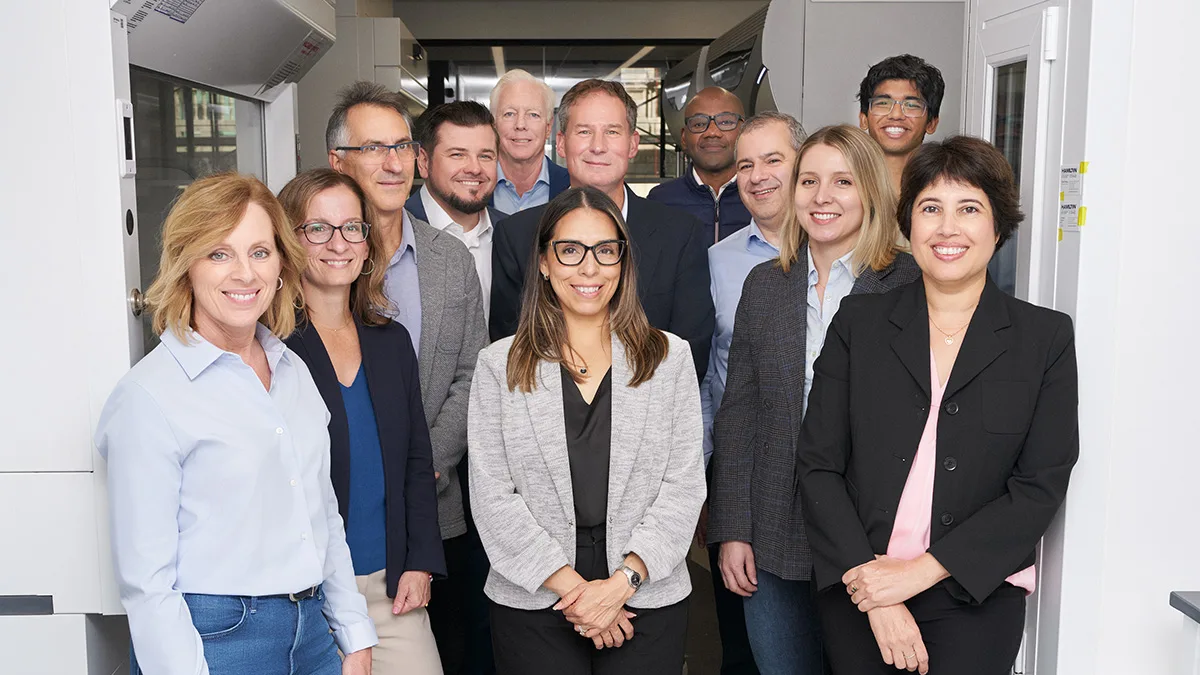
Excelsior Sciences team. Courtesy of Excelsior Sciences.
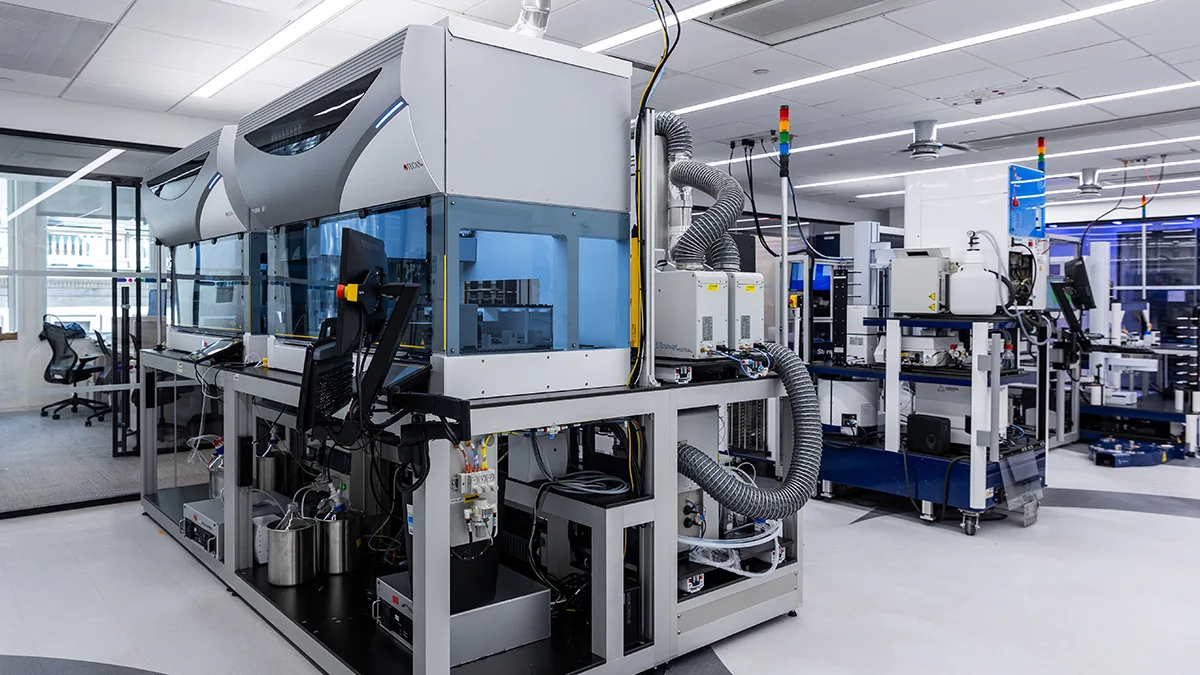
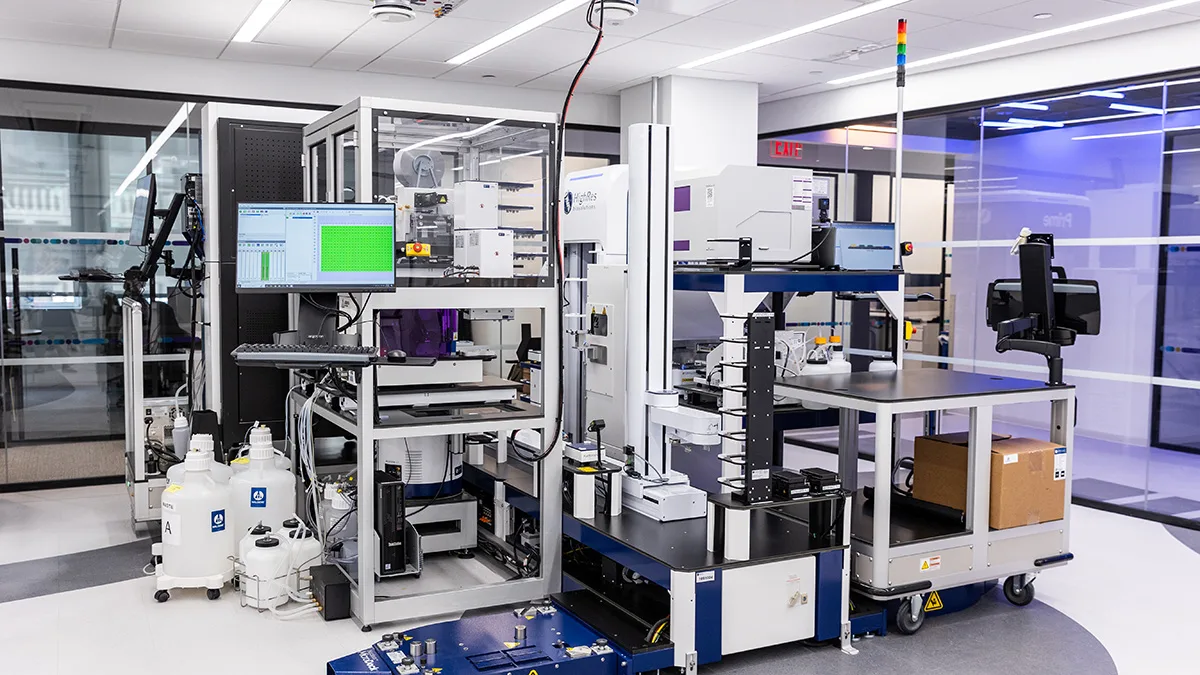
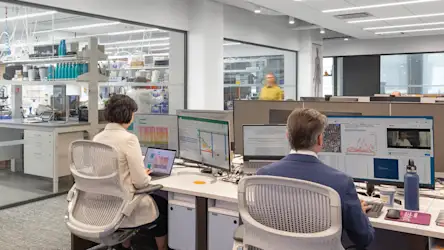
Excelsior Sciences's lab.
Many R&D groups talk about automation, but few achieve real end-to-end integration. What did you have to build—technically or culturally—to make automated chemistry actually work in practice?
MF: It’s great you use the word “culturally” because that cuts right to the heart of the issue. The culture of small-molecule chemistry has been defined by a highly artisanal approach, limiting participation to a relatively small number of extensively trained chemists or artisans. In order to transform small molecule chemistry for the modern era and take advantage of critical innovations like AI, we need to turn our approach to chemistry on its head.
That’s what Excelsior Sciences is doing. We’ve created a modular approach to chemistry that’s specifically designed for automation, and which is utterly unique within the industry. Our smart bloccs platform represents a new chemical ‘language’ that AI can learn from. Technology alone can’t break chemistry’s 200-year ‘artisanal roadblock’; it requires a cultural change in the way we think about the tools at our disposal. That’s what we’ve achieved with smart bloccs: a simplified yet powerful approach that will completely transform how small molecules are discovered in the future.
Block-based chemistry sits at the heart of your platform. Can you explain how it works and why it makes chemistry “machine-friendly” in a way that traditional methods aren’t?
MF: The carbon-carbon bonds at the center of small molecules are incredibly difficult and labor-intensive to form; they require scientists to leverage thousands of different reactions under a huge range of conditions, working with millions of different starting materials.
Excelsior’s proprietary chemistry approach enables iterative carbon-carbon bond formation, leveraging smart bloccs and a powerful protecting group that is analogous to FMOC used in automated peptide synthesis to form carbon-nitrogen bonds. This approach simplifies the highly complex world of small molecules to a finite number of starting materials, and just a few reactions under generation conditions.
This simplified approach is ideal for automation. Additionally, our smart bloccs act as “tokens” in the same way that words are tokens for large language models. This enables AI to learn and begin to predict drug properties in the same way that it learns meaning and predicts language with applications like ChatGPT. Excelsior’s smart bloccs are synthesis-friendly, AI-readable chemical ‘building blocks’ that can be snapped together in any combination, facilitating the rapid discovery of new small molecule solutions.
One of the most intriguing parts of your platform is the ability to revive abandoned or “fallen angel” molecules. Why do so many promising compounds get shelved, and what does Excelsior enable that wasn’t possible before?
MF: A drug in development can show incredible promise, only to fail once its properties are more fully understood. Sometimes this is over lack of efficacy, but oftentimes it’s simply a matter of poor drug-like properties, e.g. it can’t cross the cell membrane, or it isn’t stable in the body, or it causes toxicity. These fallen angels could be highly effective drugs if we had the ability to predict and fix these properties.
That’s exactly what our modular smart bloccs platform achieves.
We can look at the functions of these fallen angels to examine what makes them work as a drug, but also what limits them. We can tune out the toxicity, for example, or optimize their pharmaceutical properties, enabling scientists to turn promising compounds into viable candidates, cost-effectively and with greater certainty than ever before.
The fragility of global supply chains has become impossible to ignore. How do you see Excelsior contributing to reshoring drug development and strengthening national resilience around critical medicines?
MF: The United States has a major vulnerability that hardly anyone is talking about: our overreliance on offshored pharmaceuticals. Today, 91% of US prescriptions are for generic drugs; of these, 85% are manufactured in China or India
Reshoring has become a strategic priority, but the way global drug supply chains have evolved makes this incredibly difficult. You have starting materials and/or drug molecules created where it’s cheapest to do so, which means that the West has largely lost the ability to discover and manufacture small molecules.
Excelsior Sciences’ modular platform uniquely enables reshoring of closed-loop discovery and manufacturing, taking advantage of advances in automation and AI to make these economically viable to do in the West. Our chemistry marries well with advanced manufacturing techniques that leverage more automation and require a significantly smaller infrastructure footprint. The ability to seamlessly scale manufacturing is crucial for slashing the overall cost and time of drug development. Excelsior’s approach will strengthen supply chains and give the US “strategic immunity” to any macro factors that could disrupt access to essential medicines.
Looking ahead, what does success look like for Excelsior over the next decade? If you achieve your vision, how will scientists, companies, and patients experience the impact of this “chemistry revolution”?
MF: We get asked a lot which diseases we want to prioritize, but our vision goes further than any one application. Excelsior Sciences sees a future where there is no impediment to developing new cures, and therapeutics; where we don’t have to prioritize one illness over another because we lack the resources, be it money, time, or human capital. And because we are transforming small-molecule chemistry and discovery, we will impact many industries beyond therapeutics, bringing safer, more effective solutions to human and planetary challenges.