




Cure
Overview
As next-generation editing tools move from bench to bedside, these ten companies are leading the charge toward a new era of genetic medicine.
In 2023, Casgevy (exagamglogene autotemcel) became the first CRISPR-based gene-editing therapy to get FDA approval, a move that was hailed as a milestone for the technology and its developers CRISPR Therapeutics and Vertex Pharmaceuticals.
Casgevy treats sickle cell disease and beta-thalassemia using CRISPR-Cas9 editing to switch on a gene in patients’ blood stem cells that boosts their amount of oxygen-carrying hemoglobin. Researchers are now turning to next-generation CRISPR editing technologies that are more precise and versatile than CRISPR-Cas to potentially treat a range of other disorders, for patients who have no or few treatment options.
“Right now, we’re at a point where, for almost any pathogenic genetic variant, you can at least imagine a plausible CRISPR or RNA-based strategy to target it,” says Krishanu Saha, PhD, Program Lead of the CRISPR Vision Program at the University of Wisconsin-Madison.
Moreover, CRISPR editing is converging with other disciplines such as machine learning and AI, cell-free manufacturing, and increasingly autonomous labs to speed therapies to patients. “The lag between discovering a disease-causing mutation and having a candidate therapy on the bench is shrinking dramatically,” says Saha.
Indeed, in 2025, clinicians and researchers developed a CRISPR therapy for a baby with a rare genetic disease in a mere six months. He became the first person to receive a bespoke base-editing therapy, which corrected his inability to process toxic nitrogen-containing compounds.
Base editing uses enzymes such as a deaminase to alter the chemical nature of DNA bases and generate precise point mutations.
Other forms of next-generation CRISPR editing include PASTE, which can insert large genetic sequences into the genome, making it more efficient for gene therapies. Prime editing works in both dividing and non-dividing cells, making it useful for correcting mutations in neurons, for example. Epigenetic editing adds or removes chemical tags, allowing researchers to fine-tune gene output.
Despite the excitement around CRISPR editing and the tantalizing potential to cure genetic disorders, Saha cautions the field’s need to ensure trials remain anchored in genuine patient need, with long-term follow-up, and don’t drift into non-medical domains such as reproductive design.
Rare genetic disorders, including cardiovascular disease and degenerative disorders, are the primary focus areas right now for developers of CRISPR-based medicines, with several trials reporting preliminary results. “It’s exciting to see more and more positive outcomes [from such trials],” says Xuebing Wu, PhD, Assistant Professor at Columbia University Irving Medical Center. Developers are also taking aim at disorders that affect larger populations, such as hepatitis B infection. “I’m particularly interested in seeing the field push toward more creative and scalable applications for common diseases,” says Wu.
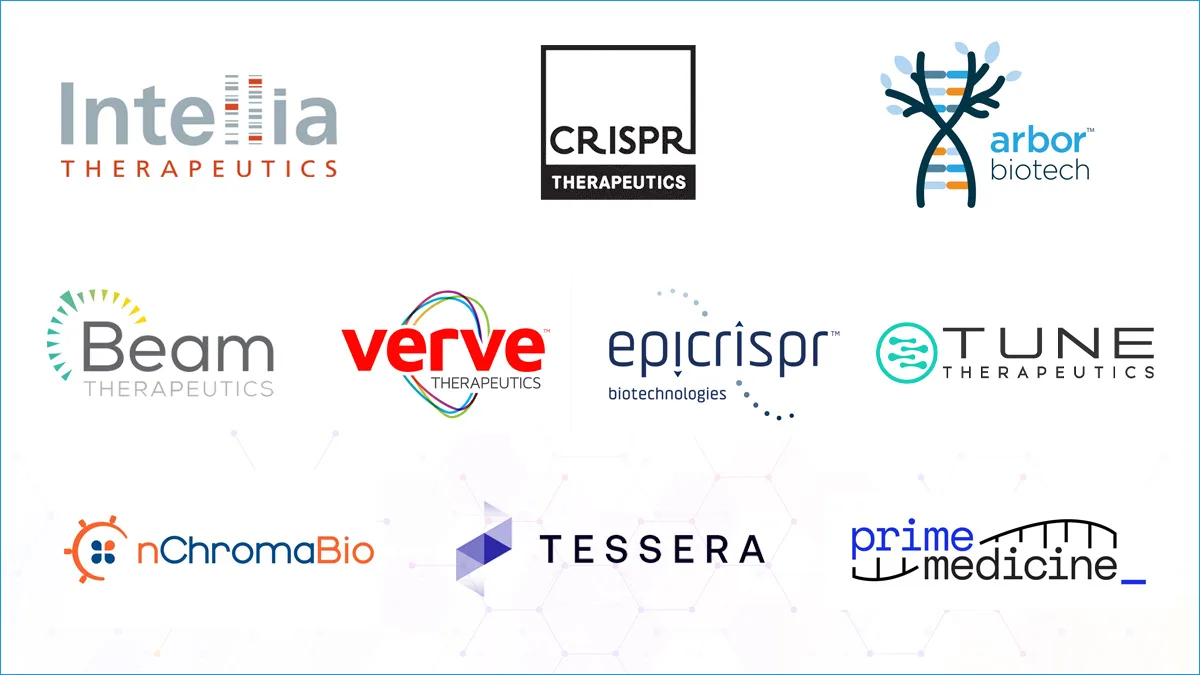
The following companies are at the forefront of advancing CRISPR-based gene editing through clinical trials.
Intellia Therapeutics
Sector: CRISPR-Cas
HQ: Cambridge, MA
Year Founded: 2014
Origin Story: The company was founded by Caribou Biosciences, which is also a CRISPR gene editing company, and Atlas Venture, with scientists including CRISPR pioneer Jennifer Doudna and John Leonard, who was formerly CSO of AbbVie.
Key Leaders: John Leonard, MD, President and Chief Executive Officer; David Lebwohl, MD, Chief Medical Officer; Birgit Schultes, PhD, Chief Scientific Officer
Number of Employees: ~377
Stage: Public
Financial Snapshot: Market cap of $1.51 billion in March 2026
Key Products: The company has two products in late-stage clinical trials. Lonvoguran ziclumeran (lonvo-z) prevents swelling attacks in hereditary angioedema by inactivating the KLKB1 gene in the liver. Nexiguran ziclumeran (nex-z) targets the TTR gene that encodes for the transthyretin in hepatocytes, and is in clinical trials, partnered with Regeneron, for transthyretin amyloidosis that affects the heart or nerves.
Recent Highlights: In November 2025, the company presented phase 1 data showing that a single dose of nexiguran ziclumeran reduced transthyretin levels in the blood of patients with transthyretin amyloidosis with cardiomyopathy. The drug also stabilized or improved markers of cardiomyopathy progression, even in patients with advanced heart failure.
CRISPR Therapeutics
Sector: CRISPR-Cas
HQ: Boston, MA (global headquarters in Zug, Switzerland)
Year Founded: 2013
Origin Story: The company was founded by Emmanuelle Charpentier, who won the 2020 Nobel Prize in Chemistry, alongside Shaun Foy and Rodger Novak
Key Leaders: Samarth Kulkarni, PhD, Chief Executive Officer; Naimish Patel, MD, Chief Medical Officer
Number of Employees: ~480
Stage: Public
Financial Snapshot: In March 2026, CRISPR announced it would raise an upsized $550 million through a convertible senior notes offering.
Key Products: Casgevy is FDA-approved for treating sickle cell disease and beta thalassemia. Other products in clinical trials include zugocaptagene geleucel (zugo-cel), a CRISPR-Cas9 gene-edited CAR-T cell therapy. With regard to CRISPR, the company also has two in-vivo gene-editing therapies in clinical trials for cardiovascular disease: CTX310 that targets ANGPTL3 to regulate lipid metabolism, and CTX320 that targets LPA to regulate lipoprotein(a) levels.
Recent Highlights: In November 2025, phase 1 data published in the New England Journal of Medicine showed that a single dose of CTX310 reduced ANGPTL3 levels in patients, which led to clinically meaningful reductions (by about 50%) in triglyceride and bad LDL cholesterol levels.
Arbor Biotechnologies
Sector: CRISPR-Cas
HQ: Cambridge, MA
Year Founded: 2016
Origin Story: Founded by the Broad Institute’s Feng Zhang with former students David Scott and Winston Yan, alongside Harvard professor David Walt.
Key Leaders: Devyn Smith, PhD, Chief Executive Officer; John Murphy, PhD, Chief Scientific Officer; Dan Ory, MD, Chief Medical Officer
Number of Employees: ~110
Stage: Private, Series C
Financial Snapshot: The company raised $73.9 million Series C financing in March 2025, and in October of the same year it received an undisclosed equity investment from Samsung Life Science Fund.
Notable Investors: Cure Experience Services (accelerator), Aberdeen Investors, Kerna Ventures, Partners Investments, Qatar Investment Authority, ARCH Venture Partners, TCGX
Key Products: ABO-101 inactivates the HAO1 gene in the liver to treat primary hyperoxaluria type 1, a rare metabolic disorder characterized by overproduction of oxalate. It’s is in phase 1/2 trial partnered with Chiesi
Recent Highlights: The first patient was dosed in this trial in July 2025, and there were no serious adverse events reported. Preclinical studies showed that a single dose of ABO-101 reduced urinary oxalate levels for one year in a mouse model.
Beam Therapeutics
Sector: Base editing
HQ: Cambridge, MA
Year Founded: 2017
Origin Story: The company was founded by CRISPR researchers David Liu, Feng Zhang, and J. Keith Joung from the Broad Institute of MIT and Harvard.
Key Leaders: John Evans, Chief Executive Officer; Giuseppe Ciaramella, PhD, President; Amy Simon, MD, Chief Medical Officer; Gopi Shanker, PhD; Chief Scientific Officer Manmohan Singh, PhD, Chief Technology Officer
Number of Employees: ~511
Stage: Public
Financial Snapshot: In February 2026, the company announced a $500 million strategic financing facility with Sixth Street to fund the potential launch of its lead product ristoglogene autogetemcel (risto-cel) in sickle cell disease.
Key Products: Risto-cel, which activates the gene encoding fetal hemoglobin to boost the oxygen-carrying capacity of red blood cells, is in a phase 1/2 trial in people with sickle cell disease. Two other products are in phase 1/2 clinical trials for genetic liver diseases: BEAM-302 corrects the E342K mutation in alpha-1 antitrypsin deficiency, and BEAM-301 corrects the R83C mutation in glycogen storage disease Ia.
Recent Highlights: Data released in December 2025 showed that risto-cel increased blood fetal hemoglobin levels to above 60% in 31 patients with severe sickle cell disease. What’s more, patients no longer experienced anemia after treatment, and remained anemia-free at their follow-up, of up to 20 months.
Verve Therapeutics
Sector: Base editing
HQ: Cambridge, MA
Year Founded: 2018
Origin Story: Verve was co-founded by cardiologist and geneticist Sekar Kathiresan, who identified genetic mutations that protect against heart-attack risk
Key Leaders: Sekar Kathiresan, MD, Chief Executive Officer
Number of Employees: ~274
Stage: Run as wholly owned subsidiary of Eli Lilly
Financial Snapshot: Verve was acquired by Eli Lilly in June 2025 for approximately $1.0 billion upfront
Key Products: Two in-vivo gene-editing products are in clinical development for cardiovascular disease: VERVE-201 targets the ANGPTL3 gene in the liver to reduce and triglyceride levels, while VERVE-102 inactivates the PCSK9 gene in the liver to reduce LDL cholesterol.
Recent Highlights: Clinical results released in April 2025 showed that VERVE-102 decreased blood PCSK9 protein levels by 46–60% and LDL cholesterol levels 21–53% in patients with heterozygous familial hypercholesterolemia and/or premature coronary artery disease.
Epicrispr
Sector: Epigenomic editing
HQ: South San Francisco, CA
Year Founded: 2018 (formerly called Epic Bio)
Origin Story: The company was founded by Stanford University’s Lei Stanley Qi, PhD, who was a doctoral candidate in Jennifer Doudna’s lab at the University of California.
Key Leaders: Amber Salzman, PhD, Chief Executive Officer; Weston Miller, MD, Chief Medical Officer; Alexandra Collin de l’Hortet, PhD, Vice President, Therapeutics
Number of Employees: ~43
Stage: Private, Series B
Financial Snapshot: The company secured $68 million funding in March 2025 to begin clinical trials of its lead product
Notable Investors: Ally Bridge Group, SOLVE FSHD, Horizons Ventures, LDV Partners
Key Products: The epigenetic modulator EPI-321 is in a phase 1 trial for the genetic muscle disorder facioscapulohumeral muscular dystrophy. It works by re-methylating the D4Z4 region of the DUX4 gene in skeletal muscle.
Recent Highlights: Early data of three patients released in January 2026 showed that EPI-321 improved their muscle strength (compared with a natural history control group) and did not cause any severe adverse events.
nChromaBio
Sector: Epigenetic editing
HQ: Boston, MA
Year Founded: Founded in 2024 through the merger of Chroma Medicine and Nvelop Therapeutics
Origin Story: Both Chroma and Nvelop were founded by gene therapy scientists David Liu and Keith Joung, alongside other scientists.
Key Leaders: Jeffrey Walsh, Chief Executive Officer; Melissa Bonner, PhD, Chief Scientific Officer; Jenny Marlowe, PhD, Chief Development Officer
Number of Employees: ~92
Stage: Private, early-stage VC
Financial Snapshot: Oversubscribed $75 million financing in 2024
Notable Investors: 5AM Ventures, Alexandria Venture Investments, Cormorant Asset Management, ARCH Venture Partners, Atlas Venture, Casdin Capital, and Newpath Partners
Key Products: The company’s lead program is CRMA-1001, is a liver-directed epigenetic therapy for chronic hepatitis B that’s designed to shut down viral antigen expression and HBV replication by targeting both types of HBV DNA.
Recent Highlights: The first patient in the clinical trial received CRMA-1001 in January 2026; the trial aims to enrol 66 patients and read out in 2032.
Tune Therapeutics
Sector: Epigenetic editing
HQ: Durham, NC and Seattle, WA
Year Founded: 2020
Origin Story: A Duke University spin-out founded by Charles Gersbach and colleagues
Key Leaders: John McHutchison, Chief Executive Officer; Akira Matsuno, President; Derek Jantz Chief Scientific Officer
Number of Employees: ~75
Stage: Private, Series B
Financial Snapshot: The company received $175M in financing in January 2025
Notable Investors: Biovison Ventures, Duke Capital Partners, New Enterprise Associates, Pappas Capital, Yosemite, Regeneron Ventures, and Hevolution Foundation
Key Products: Tune-401 is designed to treat chronic hepatitis B by targeting the two types of HBV DNA to inactivate the virus.
Recent Highlights: A first-in-human trial of Tune-401 began in 2024 and in the same year the company highlighted preclinical data showing that the product showed durably repressed HBV DNA levels in cell and animal models.
Tessera Therapeutics

Sector: Gene writers, which insert DNA sequences into genes using mobile genetic elements such as retrotransposons, using RNA as a template, through a process known as target-primed reverse transcription.
HQ: Somerville, MA
Year Founded: 2018
Origin Story: Founded by Flagship Pioneering
Key Leaders: Michael Severino, Chief Executive Officer; David Davidson, Chief Medical and Development Officer; Michael Holmes, Chief Scientific Officer
Number of Employees: ~292
Stage: Private, Later Stage VC
Financial Snapshot: The company struck a December 2025 deal with Regeneron, worth $150 million upfront to develop its lead product for alpha-1 antitrypsin deficiency, a disorder that affects patients’ lungs and liver.
Notable Investors: Flagship Pioneering and others, including Gates Foundation; Abu Dhabi Investment Authority; Altitude Life Science Ventures; Catalio Capital Management; ARTIS Ventures; Cormorant Asset Management
Key Products: TSRA-196 is in a phase 1/2 trial in patients with alpha-1 antitrypsin deficiency and is designed to correct mutations in the SERPINA1 gene that encodes alpha-1 antitrypsin.
Recent Highlights: Preclinical data presented in May 2025 showed that a single dose of TSRA-196 had an editing efficiency of 76% at the SERPINA1 locus in hepatocytes.
Prime Medicine

Sector: Prime editing
HQ: Cambridge, MA
Year Founded: 2021
Origin Story: Founded by David Liu and Andrew Anzalone who developed prime editing at the Broad Institute of MIT and Harvard
Key Leaders: Allan Reine, MD, Chief Executive Officer; Ann Lee, PhD, Chief Technical Officer; Mohammed Asmal, MD, Chief Medical Officer
Number of Employees: ~146
Stage: Public
Financial Snapshot: Market cap of $659.02 million in March 2026
Key Products: PM359 is designed to correct a mutation in the NCF1 gene that causes chronic granulomatous disease, which leaves patients highly susceptible to bacterial and fungal infections.
Recent Highlights: In December 2025 the company published the first clinical trial of base editing, in two people with chronic granulomatous disease – a rare autoimmune disorder. Treatment with PM359 restored the function of the enzyme NADPH oxidase in the patients’ immune cells, likely enabling them to fight infections more effectively.