

Overview
In a recent keynote, NCATS director Joni Rutter laid out why so many scientific findings go unpublished, and what the NIH is building to change it.
Joni Rutter's full keynote at Catalyst NYC: The Future of Translational Science, delivered July 11, 2026, is available in Cure's membership community.
Scientists rarely publish experiments that fail. Scientific journals favor positive, novel results, and there's little professional credit in reporting a dead end, so negative findings usually go unrecorded.
The waste comes later, when another lab, unaware the work was ever done, runs the same experiment and reaches the same negative result, after spending grant money and enrolling patients to get there.
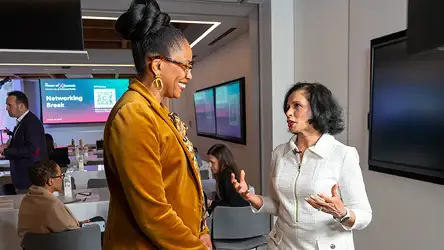
Joni Rutter, PhD, Director of the National Center for Advancing Translational Sciences (NCATS) at the National Institutes of Health (NIH), described the problem during a recent keynote at Catalyst NYC: The Future of Translational Science, a conference hosted by ResearchHub Foundation. She said the science itself is working but connecting the findings to one another is the missing link.
"The literature is really good at finding positive results, but it's not very good at finding negative results," Rutter said. "And that's a problem."
The timing isn't incidental. NIH is now asking the research community how to rethink what counts as scientific success, and how to reward the kind of rigor and sharing that current publication-and-citation metrics don't. The agency opened a public comment period in June, running through August 19, as part of a broader push to move its measures of success away from raw output and toward research that holds up and gets reused.
Making Research Machine-Readable
The core problem is that useful findings are impossible to find. Rutter's answer is a program called LitCoin, still in development at NCATS, that would record results in a form computers can actually search.
A researcher writes up an observation as a short abstract and submits it through a journal. Software extracts the specific claims, the author and publisher confirm them, and once the paper is accepted those claims join a shared, searchable record of what has been found. The goal is to make knowledge cumulative the moment it is published, instead of leaving it scattered across thousands of documents no one has time to read.
"We want to generate knowledge that accumulates, not knowledge that's fragmented," Rutter said.
That accumulated record is what powers another NCATS tool, the Biomedical Data Translator, which mines connections across more than 200 data sources to flag existing drugs that might treat diseases they were never designed for. But it only works if the underlying findings are there to connect.
Outsourcing the Second Look
A drawer full of unpublished negatives is one gap in the record. A separate one is the published finding that doesn't hold up when another lab tries to repeat it; Rutter cited an estimate that at least half of published work can't be reproduced in an industrial setting during early drug discovery.
But almost no one re-runs someone else's experiment to see if it holds up, because there's no payoff in it. Researchers get hired, funded, and promoted for new findings, less so for confirming old ones, and journals aren't eager to publish those confirmations either.
One NIH program takes that problem on directly. Through the Common Fund, the agency pays contract research firms to repeat selected NIH-funded studies and report whether the results hold up. It's a pilot, meant to show which kinds of studies are worth repeating and under what conditions.
A Model for the Whole Field
According to Rutter, no solution works if it stops at NIH's door, because the problem is built into the way science rewards people. Researchers get hired, funded, and promoted for new findings, so that's what they go after, while sharing everything you find or checking whether someone else's result holds up does little for a career, and journals lean the same way by favoring novelty over confirmation. What Rutter is arguing is that none of this shifts unless labs, journals, universities, and funders all move at once, rather than one agency building tools on its own.
"The challenge for us isn't just to think outside of our box," Rutter said. "It is also to build a system where evidence doesn't stay trapped inside of our own little bubbles."