


Overview
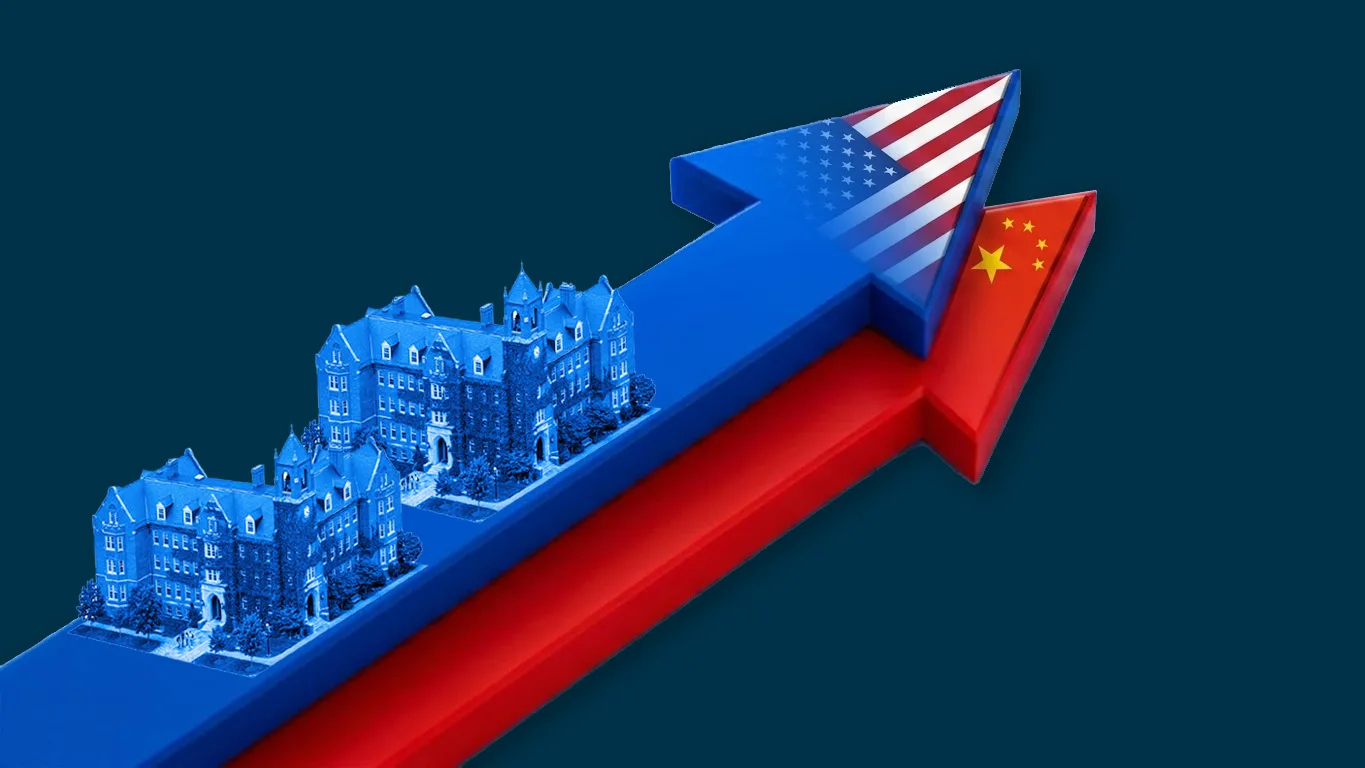
China has caught up to the United States on the volume of biomedical research, but American universities and research institutions still hold a wide lead on influence.
China has drawn even with the United States in the volume of biomedical research, crossing ahead of top U.S. institutions on a per-institution basis around 2022, according to a Cure Innovation Index analysis of publication data. Annual output across the leading institutions in each country now runs at a similar level, roughly 43,500 papers apiece. What decides the lead is no longer volume but influence — the degree to which a body of research shapes the field around it.
US research draws more citations per paper, the mark of work that shapes a field. The analysis puts US impact at a Mean Relative Citation Ratio of 2.38 against China’s 1.82, an edge of 31 percent. That ratio, developed by the National Institutes of Health (NIH), compares each paper to the average for its field and year, where 1.0 marks typical NIH-funded research.
Based on Cure’s analysis of publication data, America’s influence lead is widest in four frontier fields, the areas that will define next-generation medicine: CRISPR & gene editing, CAR-T & cell therapy, R NA therapeutics, AI drug discovery. US influence runs 90 percent higher in CAR-T and cell therapy, 60 percent in RNA therapeutics, 53 percent in AI drug discovery, and 45 percent in gene editing. Furthermore, the data shows that a focused group of American institutions produces the lion’s share of work behind that edge.
Frontier Fields Where US Science Holds the Lead
There’s a premium on getting to a field early. The opening papers frame what the field is about, and they keep drawing citations long after. That premium doesn’t last, though, and once the methods are everywhere, so is the expertise.
Three of the four frontier fields began in US labs, and that head start still shows. CAR-T grew out of US research, first at the National Cancer Institute and later at the University of Pennsylvania. That work led to the first approved therapy in 2017. RNA therapeutics traces back to US scientists as well. Craig Mello at the University of Massachusetts and Andrew Fire, then at the Carnegie Institution, discovered RNA interference, a way to switch off specific genes. Years later, Katalin Karikó and Drew Weissman at Penn won the 2023 Nobel Prize for the messenger RNA work behind the COVID vaccines. Gene editing took a similar path, with much of the early work in human cells done in the United States.
Funding and citation patterns widen the gap. The NIH is the biggest funder of high-impact biomedical research, and that public money covers the costly early work these fields need, though proposed cuts and new grant rules have disrupted funding over the past year. Chinese papers also draw more of their citations from inside China than US papers do, so a large body of work ends up with less reach abroad. The Relative Citation Ratio (RCR) accounts for this, because it weighs each paper against others in the same field and year rather than counting citations outright.
The fourth field is different. AI drug discovery is the youngest of the four, and the only one that did not start in US labs. The modern wave began around 2012, when advances in deep learning let computers find patterns across large sets of biological and chemical data. Its signature breakthrough came from outside the United States. AlphaFold, built by Google DeepMind in London, predicted the shapes of nearly every known protein. That problem had stumped biologists for decades, and its creators won a share of the 2024 Nobel Prize in Chemistry.
The work is also more spread out than the other three fields. Much of it happens at companies rather than universities, and those companies sit around the world, from the United States to Britain to China. China is strong in AI research as a whole. The data shows the US ahead by 53 percent in AI drug discovery, but the field is young and the lead is far from settled. This is the field where the race could tighten first.
Below, we have outlined the institutions doing this work, ranked by how much of their biomedical research concentrates in these four fields. The ranking is based on data from the.
Based on the data from the Cure Innovation Index, we have outlined the institutions doing this work, ranked by frontier intensity — the share of each institution’s biomedical research that falls into these four fields. Because the measure reflects focus rather than size, a small specialist institution can rank above a much larger one.
Leading Research Institutes and Centers
These 10 institutes rank highest on frontier intensity. As a group, they spread their focus across all four fields, with clear specialists in each.
Jackson Laboratory. A nonprofit known for genetics research. Gene editing makes up the largest share of its frontier work, followed by RNA therapeutics.
Broad Institute. A center for gene-editing research, where scientists helped turn CRISPR into a working tool for human cells. Gene editing accounts for about half of its frontier output.
Sanford Burnham Prebys. A nonprofit biomedical research institute in San Diego. RNA therapeutics dominate its frontier work.
City of Hope. A cancer research and treatment center. Its frontier work divides between CAR-T cell therapy and RNA therapeutics.
St. Jude’s Children’s Hospital. A pediatric research hospital focused on childhood disease. Its frontier output spreads across gene editing, CAR-T, and RNA therapeutics.
Salk Institute. A basic-science research institute. Gene editing and RNA therapeutics split its frontier work about evenly.
Scripps Research. A nonprofit biomedical research institute. RNA therapeutics leads its frontier output by a wide margin.
Dana-Farber Cancer Institute. A cancer center in Boston. Its frontier work spreads across gene editing, CAR-T, and RNA therapeutics.
H. Lee Moffitt Cancer Center. The clearest cell-therapy specialist on the list. CAR-T makes up most of its frontier work, matching the field where the US lead over China runs widest.
Fred Hutchinson Cancer Center. A cancer research center in Seattle. CAR-T and cell therapy lead its frontier work, with strong output in RNA therapeutics.
Leading Universities
The universities cluster more tightly than the institutes. Most concentrate in RNA therapeutics, the field that uses genetic messengers to switch proteins on or off.
Rockefeller University. A research university focused on biomedical science. RNA therapeutics and gene editing lead its frontier work.
Texas A&M Health Science Center. RNA therapeutics leads its frontier output. It also holds the largest share in AI drug discovery among these institutions.
University of Massachusetts Medical School. Its frontier work weighs heavily toward RNA therapeutics.
University of Texas M. D. Anderson Cancer Center. A cancer center in Houston. RNA therapeutics and CAR-T together make up most of its frontier output.
Louisiana State University Health Sciences Center-Shreveport. The most concentrated institution in the dataset. RNA therapeutics accounts for the large majority of its frontier work.
University of Kansas Medical Center. RNA therapeutics leads its frontier output.
Baylor College of Medicine. A medical school in Houston. RNA therapeutics leads, with a meaningful share in gene editing.
University of Nebraska Medical Center. RNA therapeutics concentrates much of its frontier work.
Loma Linda University. RNA therapeutics leads its frontier output.
University of Oklahoma Health Science Center. Among the most RNA-weighted institutions on the university list.