




Overview
Explore the biggest biotech companies in the San Francisco Bay Area and see how the region’s mix of top research institutions, venture capital, and AI expertise keeps it at the center of global life sciences, even amid funding pressure and market recalibration.
The San Francisco Bay Area’s biotech industry includes more than 200 companies spanning over a million square feet, making it the largest biotech cluster in the world. According to John Boyd, Jr., Principal at The Boyd Company, Inc., a corporate site selection and economic development consulting firm, companies here benefit from close ties to leading institutions such as Stanford and UCSF, a highly skilled biosciences workforce, and proximity to many of the nation’s top venture capital firms.
The region’s mix of life sciences, high tech, and AI supports collaboration across funding, validation, and drug development. Still, the sector is in a period of recalibration. Tightening VC funding, increased investor caution, and notable trial failures have reshaped the market. Boyd cited a recent Ernst & Young survey finding that nearly 40 percent of Bay Area biotech companies have less than a year of cash on hand. In response, many are investing in automation and robotics to reduce long-term costs.
“I expect many of our biotech clients to utilize The One Big Beautiful Bill Act’s 100 percent bonus depreciation to buy robotics and automation equipment for long-term cost savings,” said Boyd.
Layoffs at companies including Allakos, IGM Biosciences, Cargo Therapeutics, and Genentech reflect these pressures. Even so, Boyd said most clients view the moment as a recalibration rather than a bust.
“Historically, the Bay Area biotech sector has always been able to reinvent itself, and I’m confident this recalibration will play out in 2026, especially given the impactful role that AI will be playing,” he explained.
Scaling in the Bay Area brings both advantages and constraints. “San Francisco provides unparalleled advantages for scaling a biotech company, due to the region’s unique access to talent, funding, and AI assets. Even so, hurdles still exist, most notably the high cost of living, sky-high commercial real estate, and business climate issues."
Competition and local permitting requirements add further friction. Still, Boyd pointed to strong clusters in South San Francisco, access to Silicon Valley’s AI expertise, deep VC networks, and a robust labor pool as enduring draws.
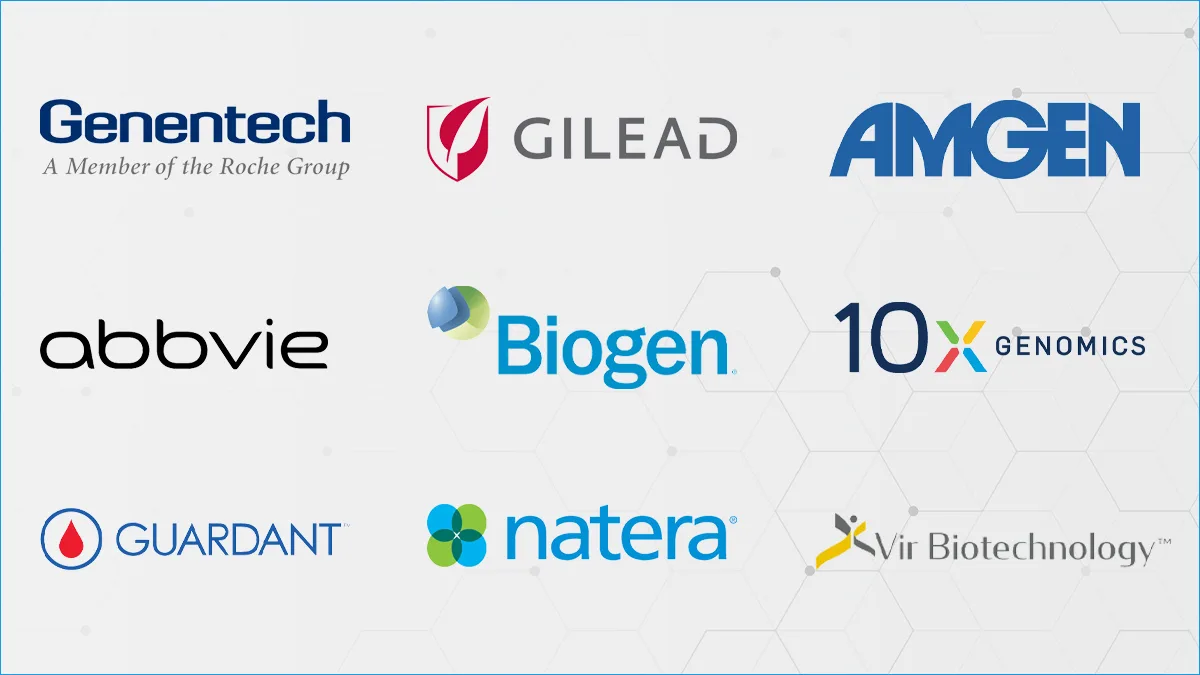
“In addition to major established players like Genentech, Gilead, and Amgen, which help create a deep ecosystem for partners and spin-offs, we are seeing companies in a range of sectors currently assessing location opportunities in the SF Bay Area,” Boyd said.
The 11 companies highlighted below represent key forces in the Bay Area ecosystem, advancing pipelines and investing in AI and other emerging technologies.
10x Genomics
Sector: Single-cell and spatial genomics platforms
HQ: Pleasanton, CA
Year Founded: 2012
Key Leaders: Serge Saxonov, PhD, Co-Founder and CEO
Number of Employees: 1,000-5,000
Stage: Public
Financial Snapshot: The company’s market cap is approximately $2.59 billion.
Key Products: 10x Genomics has a large local workforce and strong scientific influence, built around its Bay Area–based genomics platform teams. The company sells the Chromium and Visium platforms, as well as related reagents and software, to researchers worldwide.
Recent Highlights: 10x Genomics grew the usage of its single-cell and spatial technologies into oncology and immunology research and had to handle a difficult funding climate among academic clients. 10x Genomics also continued investing in new-generation platforms and workflow enhancement.
AbbVie
Sector: Immunology and oncology therapeutics
HQ: San Francisco, CA
Year Founded: 2013
Key Leaders: Robert A. Michael, Chairman of the Board and CEO
Number of Employees: ~56,000
Stage: Public
Financial Snapshot: The company’s market cap is approximately $396 billion.
Key Products: AbbVie is an immunology and oncology biotech company based in the Bay Area with its laboratories and teams. Its top products are Humira, Skyrizi, and Rinvoq in the immunology field; Venclexta and Imbruvica in the oncology field; and Mavyret for hepatitis C.
Recent Highlights: Despite a significant decline in Humira sales, AbbVie offset this drop with strong growth from Skyrizi and Rinvoq. The company also developed oncology and neuroscience pipeline programs and maintained a steady pace of clinical and regulatory achievements.
Amgen
Sector: Biologic and small-molecule therapeutics
HQ: Thousand Oaks, CA
Year Founded: 1980
Key Leaders: Robert A. Bradway, Chairman and CEO
Number of Employees: ~27,000
Stage: Public
Financial Snapshot: The market cap for Amgen is about $190 billion.
Key Products: Amgen is based in South San Francisco, where it employs significant clinical development and R&D capabilities that have influenced the biotech talent market. Some of their most remarkable biologics are Repatha, used in cardiovascular disease, Prolia and Xgeva, used in bone diseases, and Enbrel, used in inflammatory diseases.
Recent Highlights: Over the last year, Amgen has reinforced its oncology pipeline by acquiring and developing new internal research and development, increasing manufacturing capacity in the U.S., and introducing pricing and access programs to enhance the affordability of major medicines for patients.
Biogen
Sector: Neurology and neurodegenerative disease therapeutics
HQ: San Francisco, CA
Year Founded: 1978
Key Leaders: Christopher A. Viehbacher, President and CEO
Number of Employees: ~7,000
Stage: Public
Financial Snapshot: The company’s market cap is approximately $18.5 billion.
Key Products: Biogen is a neuroscience research and development company with laboratories and personnel collaborating closely with local universities. It has multiple sclerosis products, such as Tecfidera and Tysabri, spinal muscular atrophy products, such as Spinraza, and Alzheimer's disease products, such as Lequembi. Biogen's core strategic objective is neuroscience.
Recent Highlights: Biogen has focused on the commercial launch of Leqembi and on expanding reimbursement, and has reorganized to focus more on late-stage neuroscience assets. The company also refined its pipeline to concentrate on its most impactful programs.
Denali Therapeutics
Sector: Neurodegenerative disease drug development
HQ: San Francisco, CA
Year Founded: 2015
Key Leaders: Ryan Watts, PhD, Co-Founder and CEO
Number of Employees: 501-1000
Stage: Public
Financial Snapshot: The company’s market cap is approximately $2.26 billion.
Key Products: Denali is working on therapies for neurodegenerative diseases like the LRRK2 inhibitor for Parkinson's disease and biologics that cross the blood-brain barrier for rare CNS diseases.
Recent Highlights: Denali has been reporting positive clinical development news across its neuroscience programs and has been streamlining its pipeline to focus on late-stage and high-probability assets. The company still relied on its transport technology to address issues with the delivery of the central nervous system.
Genetech (Roche)
Sector: Biopharmaceutical drug discovery and development
HQ: San Francisco, CA
Year Founded: 1976
Key Leaders: Ashley Magargee, CEO
Number of Employees: ~11,900
Stage: Subsidiary of Roche (acquired in 2009)
Financial Snapshot: The company’s market cap is $344.66 billion.
Key Products: The company’s pipeline is in oncology, immunology, ophthalmology, and neuroscience. Some of the important products it employs include Avastin to treat solid tumors, Herceptin to treat HER2-positive breast cancer, and Rituxan to treat hematologic tumors and autoimmune diseases.
Recent Highlights: Over the past year, Genentech has progressed several late-stage immunology and ophthalmology programs. Another area of expansion for Genentech was AI-enabled drug discovery programs and collaborations with other researchers, especially in inflammatory and eye diseases
Gilead Sciences
Sector: Antiviral and immunology therapeutics
HQ: Foster City, CA
Year Founded: 1987
Key Leaders: Daniel O’Day, Chairman and CEO; Deitmar Berger, MD, Chief Medical Officer
Number of Employees: ~17,000
Stage: Public
Financial Snapshot: The company’s market cap is $170.9 billion.
Key Products: Gilead Sciences has a well-developed R&D and manufacturing base and a long-term investment, with numerous local facilities. Its diverse pipeline includes therapies in virology, oncology and inflammation.
Recent Highlights: In the past year, Gilead made significant progress with lenacapavir, making it a potential twice-yearly HIV preventive with global regulatory traction. Gilead Sciences also announced early-stage data positive for Trodelvy in the first-line treatment of breast cancer and re-optimized its pipeline to focus on oncology and long-acting HIV treatments.
Guardant Health
Sector: Precision oncology and liquid biopsy diagnostics
HQ: Palo Alto, CA
Year Founded: 2012
Key Leaders: Helmy Eltoukhy, PhD, Co-founder, Chairman, and Co-CEO
Number of Employees: 1,000-5,000
Stage: Public
Financial Snapshot: The company’s market cap is approximately $15 billion.
Key Products: Guardant Health is a liquid biopsy leader with a significant presence in diagnostics, R&D, and lab services in the Bay Area. The company's products are Guardant360 and GuardantOMNI, which are liquid biopsy-based genomic profiling tests for cancer. Blood tests to help in managing cancer are also provided by Guardant Health.
Recent Highlights: Guardant made several improvements to its oncology diagnostics portfolio to increase clinical adoption and provide additional information about the use of liquid biopsy in therapy decision-making. Guardant continued investing in research efforts for early cancer detection.
Natera
Sector: Genetic and molecular diagnostics
HQ: San Carlos, CA
Year Founded: 2004
Key Leaders: Steve Chapman, CEO; Eric Evans, PhD, Chief Scientific Officer; Rishi Cacker, Chief Technology Officer; John Ryan, PhD, Chief Laboratory Officer
Number of Employees: ~2,670
Stage: Public
Financial Snapshot: The company’s market cap is approximately $24 billion.
Key Products: Natera is a large clinical diagnostics employer with a large Bay Area lab and R&D workforce. The company sells Panorama, non-invasive prenatal testing; Horizon, carrier screening; and Signatera, personalized circulating tumor DNA testing for oncology and transplant monitoring.
Recent Highlights: Natera has seen robust adoption of Signatera across oncology and transplant settings, along with expanding reimbursement coverage. The company also furthered clinical evidence of increased use of its molecular diagnostics.
Twist Bioscience
Sector: Synthetic biology and DNA synthesis
HQ: San Francisco, CA
Year Founded: 2013
Key Leaders: Emily Leproust, PhD, Co-Founder and CEO; Siyuan Chen, PhD, Chief Technology Officer
Number of Employees: 501-1000
Stage: Public
Financial Snapshot: The company’s market cap is approximately $1.89 billion.
Key Products: Twist Bioscience provides synthetic DNA products, including gene fragments, oligo pools, and NGS target enrichment tools for research and diagnostics.
Recent Highlights: Twist focused on improving margins and scaling its DNA manufacturing platform, and increased collaboration in genomics and biopharma. The company also introduced new products targeting the clinical and applied genomics markets.
Vir Biotechnology
Sector: Immunology and infectious disease therapeutics
HQ: San Francisco, CA
Year Founded: 2016
Key Leaders: Marianne De Backer, PhD, Chief Executive Officer and Director
Number of Employees: 201-500
Stage: Public
Financial Snapshot: The company’s market cap is approximately $0.79 billion.
Key Products: The company is developing immunology-based therapies, including monoclonal antibodies and T-cell engager programs, for infectious diseases and cancer targeting.
Recent Highlights: Vir Biotechnology shifted its strategy to oncology and moved early-stage T-cell engager programs into the clinic. After the COVID-related programs ended, Vir Biotechnology also narrowed its portfolio to focus on fewer, higher-conviction assets.