




Cure
Overview
Explore the biggest and most groundbreaking biotech companies in San Diego, and discover why the region remains one of the most vibrant life science hubs in the US.
San Diego is one of the country’s most productive biotech ecosystems, with life sciences companies spread across Torrey Pines, UTC, Sorrento Valley, and the Mesa. The companies here remain deeply science-led, but they’re increasingly shaped by disciplined development plans, thoughtful capital strategy, and clear partnering optionality.
As David Crean, PhD, Chief Business Officer at MediciNova, explained, Boston has the deepest bench for late-stage talent, while the Bay Area offers the broadest pool for venture formation. San Diego, however, is highly efficient at turning high-quality biology into fundable, partnerable assets. “In San Diego, good science doesn’t just get published—it gets built.”
From a business and dealmaking perspective, the region has evolved. Once a “discovery-first” cluster, San Diego is now a more complete company-building engine. It stays science-led but is optimized for value inflection and transactions. Crean has noticed more repeat entrepreneurs, sophisticated syndicates, and a clearer “path to liquidity” mindset. “Teams are designing programs around pivotal clinical endpoints, clean CMC plans, and partner-ready data packages earlier than they used to,” he noted.
San Diego’s edge over other U.S. biotech hubs stems from what Crean described as its “density without bureaucracy.” A culture of fast collaboration also sets it apart. Crean explained that the Mesa is a true walkable innovation corridor as UC San Diego, Salk, Scripps Research, and Sanford Burnham Prebys interweave with startups and scaled biopharma.
Incubators and accelerators now add purpose-built launchpads. This proximity enables faster iteration from concept to IND-enabling work. “From a dealmaker’s perspective, that concentration reduces friction. It’s easier to diligence science, recruit talent, stand up labs, and access specialized service providers with a compact ecosystem,” he added.
In terms of capital, licensing, and partnerships, Crean described San Diego as a “barbell” market. The strongest stories—built on clear biology, differentiated modalities, credible leadership, and disciplined milestones—can still raise meaningful capital and attract partners. “Everything else feels tighter. Financing is more structured: tranched rounds, milestone-based pay-ins, and creative terms that reward execution,” he added.
Strategic partners remain active but now underwrite risk more explicitly. They use mechanisms such as contingent value rights and milestone economics. “From my seat, the winning teams treat capital strategy as a product. They stage proof points, curate the right counterparties, and design deal structures that preserve upside while de-risking the next 12–24 months,” Crean added.
Capital is increasingly earned, especially after the early stages. Crean noted that seed and early Series A capital still flows to differentiated biology with crisp milestones. Growth capital is more selective and milestone-driven. This pushes companies to sharpen clinical strategy, endpoint selection, and capital efficiency.
Looking toward the future, Crean expects San Diego’s next growth phase to be defined by modality-driven oncology, neuroscience and neurodegeneration, precision immunology, and industrial-strength enabling platforms.
“On the deal side, structures will keep trending toward risk-sharing—CVRs, milestones, and hybrid collaborations. Buyers want upside but are underwriting uncertainty more explicitly,” he added. In this environment, the market increasingly rewards companies that combine compelling biology, manufacturability, and a partner-ready clinical narrative.
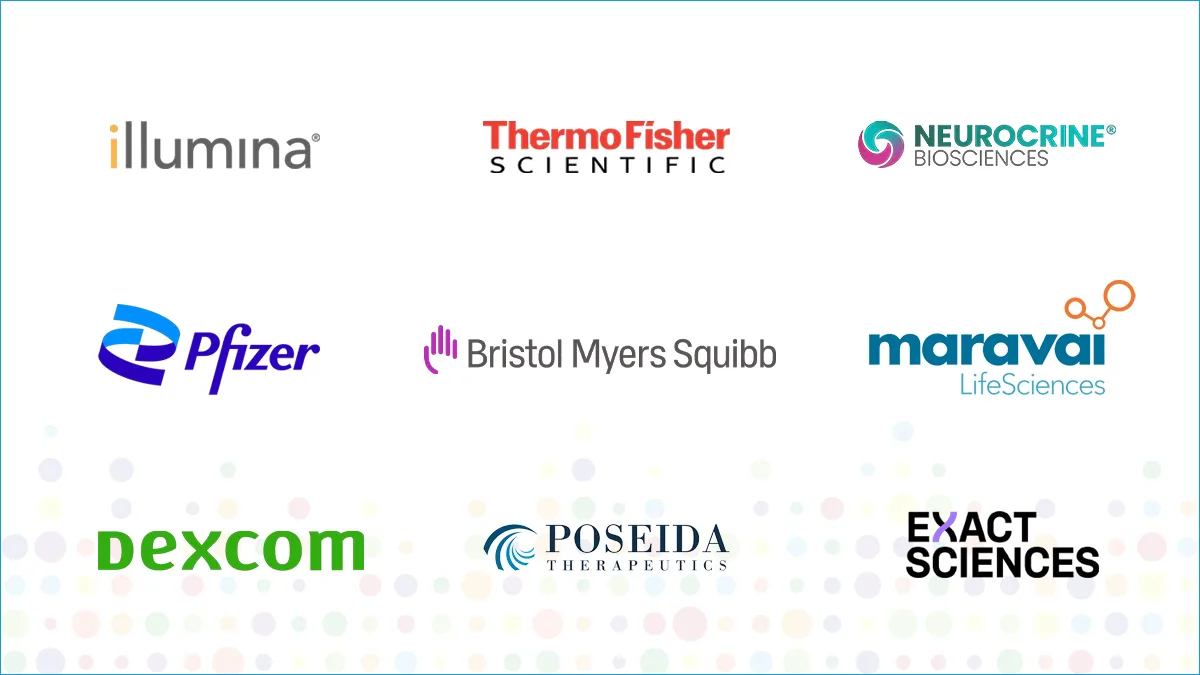
The eleven companies featured below showcase the strength of San Diego’s biotech ecosystem and how companies based here are advancing novel therapies, building late-stage programs, and building partnerships that drive life sciences innovation.
Illumina
Sector: Genomic sequencing and life‑science instruments
HQ: San Diego, CA
Year Founded: 1998
Key Leaders: Jacob Thaysen, CEO; Steve Barnard, PhD, CTO; Eric Green, MD, Chief Medical Officer
Number of Employees: ~9,000
Stage: Public
Financial Snapshot: The company’s market cap was roughly $20.53 billion in February 2026
Key Products: Illumina is one of San Diego’s biggest biotech employers, and where much of its core sequencing R&D and manufacturing is based. The company creates genomic sequencing and analysis systems like NovaSeq, NextSeq, and MiSeq, as well as microarrays and library prep kits. Their systems enable everything from clinical genomics and diagnostics to precision medicine.
Recent Highlights: Illumina announced in January 2026, that the Centers for Medicare and Medicaid Services (CMS) granted reimbursement for its FDA-approved in vitro diagnostic (IVD) TruSight Oncology (TSO) Comprehensive test. This decision will expand access to genomic profiling and personalized genomics in oncology care.
Thermo Fisher Scientific
Sector: Life sciences tools, clinical lab equipment, and bioproduction services
HQ: San Diego, CA
Year Founded: 2006
Key Leaders: Marc N. Casper, Chairman, President, and CEO
Number of Employees: ~26,000
Stage: Public
Financial Snapshot: The company’s market cap was roughly $203.83 billion as of February 2026
Key Products: Thermo Fisher Scientific is a major employer in San Diego, with operations spanning manufacturing, R&D, and lab services that support a large share of local biotech work. The company offers lab tools, reagents, consumables, and software for life sciences and diagnostics, including NGS platforms, PCR/qPCR systems, and mass spectrometry among others.
Recent Highlights: In January 2026, the company announced a strategic collaboration with NVIDIA to power AI-based solutions and laboratory automation at scale to increase the automation, accuracy and speed of laboratories. The goal is to help scientists reduce manual steps and accelerate scientific advancement.
Neuocrine Biosciences
Sector: Therapies for neurological and neuroendocrine diseases
HQ: San Diego, CA
Year Founded: 1992
Key Leaders: Kyle W. Gano, PhD, CEO; Sanjay Keswani, MD, Chief Medical Officer; Jude Onyia, PhD, Chief Scientific Officer
Number of Employees: ~2,000
Stage: Public
Financial Snapshot: The company’s market cap was roughly $13.75 billion in February 2026
Key Products: Neurocrine Biosciences sells treatments for neurological and endocrine issues, such as Ingrezza for tardive dyskinesia, Ongentys for Parkinson’s, and Orilissa for endometriosis. They also have a pipeline for congenital adrenal hyperplasia and movement disorders.
Recent Highlights: In January 2026, the company initiated a Phase 2 clinical study of investigational compound NBI-1065890 in adults with tardive dyskinesia (TD). According to a news release, NBI-1065890 is a next-generation, selective inhibitor of the vesicular monoamine transporter 2 (VMAT2). The company designed the compound to potentially offer longer-acting options for people with TD.
Pfizer
Sector: Therapies and vaccines across oncology, immunology, cardiology, and infectious disease
HQ: San Diego, CA
Year Founded: 1849
Key Leaders: Albert Bourla, PhD, Chairman and CEO
Number of Employees: ~81,000
Stage: Public
Financial Snapshot: The company’s market cap was roughly $150.61 billion in February 2026
Key Products: Pfizer’s R&D campus in La Jolla has strong ties to local research institutions and talent with a focus on oncology. Its scientists played a key role in the discovery, development, or both, of a number of cancer therapies, including Sutent (sunitinib), Xalkori (crizotinib), Inlyta (axitinib), Bosulif (bosutinib) and Ibrance (palbociclib).
Recent Highlights: Pfizer continued to see success with its COVID-19 vaccines and Prevnar. The company reported positive late-phase oncology and rare disease data and advanced its gene therapy candidates. Pfizer also expanded label prospects in internal medicine and immunology, while maintaining strong investments in global R&D.
Bristol Myers Squibb
Sector: Therapies for cancer, cardiovascular disease, immunology, and more
HQ: San Diego, CA
Year Founded: 1887
Key Leaders: Chris Boerner, PhD, Board Chair and CEO
Number of Employees: ~30,000
Stage: Public
Financial Snapshot: The company’s market cap was roughly $121.16 billion in February 2026
Key Products: Bristol Myers Squibb has a large biologics manufacturing facility representing sustained, long-term investment in San Diego County. They make drugs for cancer, immune system problems, blood conditions, and heart issues, including Opdivo, Yervoy, Eliquis, Revlimid, Camzyos, and CAR-T treatments like Breyanzi and Abecma.
Recent Highlights: In January 2026, the company announced an agreement with Microsoft with the goal of accelerating early detection of lung cancer using U.S. FDA-cleared radiology AI algorithms via Microsoft’s Precision Imaging Network.
Maravai LifeSciences
Sector: Life sciences reagents and tools
HQ: San Diego, CA
Year Founded: 2014
Key Leaders: Bernd Brust, CEO and Board Member
Number of Employees: ~570
Stage: Public
Financial Snapshot: The company’s market cap was roughly $1.13 billion in February 2026
Key Products: Maravai LifeSciences is a life science tools company whose large-scale reagent manufacturing and sizable local workforce make it a major San Diego biotech employer. They provide bioconjugation and labeling reagents, viral vector purification tools, and mRNA/DNA delivery materials for research, diagnostics, and cell/gene therapy production.
Recent Highlights: In February 2026, the company completed its acquisition of Officinae Bio’s DNA and RNA business. According to the company, this acquisition combines Officinae Bio's AI-enabled mRNA design platforms with Maravai and TriLink Bio Technologies’drug substance manufacturing capabilities. Maravai spokespeople said this will provide customers with a quick, calculated progression through the mRNA sequence-optimization phase and into clinical testing and commercial manufacturing.
Dexcom

Sector: Medical devices for continuous glucose monitoring
HQ: San Diego, CA
Year Founded: 1999
Key Leaders: Kevin Sayer, Chairman and CEO
Number of Employees: ~8,000
Stage: Public
Financial Snapshot: The company’s market cap was roughly $27.40 billion in February 2026
Key Products: Dexcom is a medical biotech company with a large concentration of San Diego–based R&D and engineering teams, shaping the local talent market. They produce continuous glucose monitoring systems, such as the G7 and Stelo, which allow for real-time glucose tracking to manage diabetes and improve patient care.
Recent Highlights: Dexcom rolled out updates for the Dexcom G7 CGM and expanded the Dexcom Stelo OTC system. The company accelerated international adoption of its CGM devices and secured new payer coverage agreements. It also continued to strengthen its presence in the diabetes market.
Poseida Therapeutics
Sector: Cell and gene therapy; with a focus on CAR-T therapies for cancer and rare diseases
HQ: San Diego, CA
Year Founded: 2014
Key Leaders: Kristin Yarema, PhD, President and CEO
Number of Employees: ~350
Stage: Acquired (Roche)
Financial Snapshot: The company’s market cap was roughly $0.92 billion market cap in March 2025
Key Products: Poseida Therapeutics is a San Diego–based cell and gene therapy biotech with significant on-the-ground R&D and manufacturing operations. They develop allogeneic and gene therapies for cancer and autoimmune diseases using CAR-T and non-viral gene editing methods. Roche bought them in 2025.
Recent Highlights: Poseida advanced its allogeneic CAR-T candidates, including P-BCMA-ALLO1, and progressed its dual CD19/CD20 programs. Roche agreed to acquire the company for $1.5 billion, and Poseida’s pipeline will be integrated into Roche’s oncology portfolio. The acquisition is expected to close in early 2026.
Exact Sciences
Sector: Molecular diagnostics and cancer screening
HQ: La Jolla, CA
Year Founded: 1995
Key Leaders: Kevin Conroy, Chairman and CEO
Number of Employees: 5,000-10,000
Stage: Acquisition pending (Abbott Laboratories)
Financial Snapshot: The market cap for the company as of February 2026 is $19.30 billion
Key Products: Exact Sciences is a diagnostics company with established lab and R&D operations in San Diego, contributing to the city’s clinical biotech footprint. They offer molecular diagnostics and cancer screening tests, including Cologuard for colorectal cancer, Oncodetect for ctDNA, and Oncotype IQ for genomic-based prognostics.
Recent Highlights: In November 2025, Exact Sciences announced a pending acquisition by Abbott Laboratories.
Crinetics Pharmaceuticals
Sector: Biopharmaceuticals for endocrine diseases
HQ: San Diego, CA
Year Founded: 2008
Key Leaders: R. Scott Struthers, PhD, Co-Founder and CEO; Stephen F. Betz, PhD, Co-Founder and Chief Scientific Officer; Dana Pizzuti, MD, Chief Medical & Development Officer
Number of Employees: ~ 430
Stage: Public
Financial Snapshot: The company’s market cap was roughly $4.59 billion in February 2026
Key Products: Crinetics Pharmaceuticals is a biotech company with a growing local workforce and labs supporting late-stage programs. They focus on rare endocrine conditions and small-molecule treatments.
Recent Highlights: In January 2026, the company announced that the first patient has been dosed in the BALANCE-CAH Phase 2/3 trial evaluating Atumelnant, for the proposed treatment of classic congenital adrenal hyperplasia (CAH) in children and adolescents. Atumelnant is a once-daily oral adrenocorticotropic hormone (ACTH) receptor antagonist candidate.
Element Biosciences
Sector: Next-gen DNA sequencing platforms for genomic research
HQ: San Diego, CA
Year Founded: 2017
Key Leaders: Molly He, PhD, Co-Founder, CEO, and Board Member; Michael Previte, PhD, Co-Founder and Chief Technology Officer
Number of Employees: ~407
Stage: Private and venture-backed
Financial Snapshot: The company raised $277 million in Series D funds in 2024
Notable Investors: Samsung Electronics and Wellington Management
Key Products: Element Biosciences is a fast-growing sequencing company with significant capital raised and expanding R&D and manufacturing operations in San Diego. They develop next-generation sequencing and multimeric platforms, including the AVITI™ sequencer and AVITI24 systems for DNA, RNA, protein, and morphological analysis.
Recent Highlights: The company expanded commercialization of the AVITI platform, unveiled advancements in multiomic systems. It also increased global research and clinical deployments, further strengthening its reach in integrated DNA, RNA, and protein profiling.