


Cure
Overview
Salt Lake City’s biotech and life-sciences industry is experiencing a lot of growth. Here are eight of the biggest biotech companies with connections to the area.
Salt Lake City’s biotech and life sciences industry has experienced significant recent growth. Over the past decade, Utah’s life sciences sector has grown by an average of 5.1% per year, according to a study from the Kem C. Gardner Policy Institute, well above the national average of 3.5%.
“Our life sci ecosystem is diverse with deep roots in medtech and medical devices, with fast growing therapeutics, diagnostics, and health tech sectors,” says Andy Robertson, Executive Director of BioHive, a nonprofit that supports Utah’s life sciences and healthcare innovation ecosystem.
Robertson points to the fact that Utah is consistently rated one of the best places to start a business and raise a family, offers a business-friendly environment, and has a lower cost of living than the coasts.
“For these reasons, we believe Utah will continue to outperform other life sciences hubs,” he says.
Salt Lake City is at the core of the hub and supported more than 41,000 life science jobs in 2023, accounting for 5.6% of county wages, more than any other county in the state. The average annual earnings in the sector are $112,197, which is 27.2% higher than other industries in the county.
John Boyd Jr., Principal of the location advisory firm The Boyd Company, says that beyond the AI-driven biotech and drug development programs at the University of Utah, the surge in Salt Lake City is fundamentally rooted in Utah’s “gold standard” business climate, characterized by low business costs, a flat corporate tax rate, and a streamlined regulatory environment that prioritizes speed to market.
“Our latest Bizcosts data shows business cost savings over 30% versus Boston and San Francisco, with savings led by labor, lower utility and water costs, lower taxes and regulations, and significantly lower lab space rental rates, along with workforce development initiatives like Utah Talent Hub, spearheaded by BioUtah and the University of Utah,” Boyd says.
He says successful biotech companies leverage the region’s unique intersection of advanced manufacturing and life sciences, particularly in biologics, diagnostics, neuro-implantable technologies, and pharmaceuticals.
“Companies that value a ‘pro-business’ philosophy, where the government acts as a partner rather than an obstacle, find that Salt Lake City offers a superior environment for both R&D and high-volume production,” Boyd says.
Here is a look at Salt Lake City companies making an impact in the biotech space.
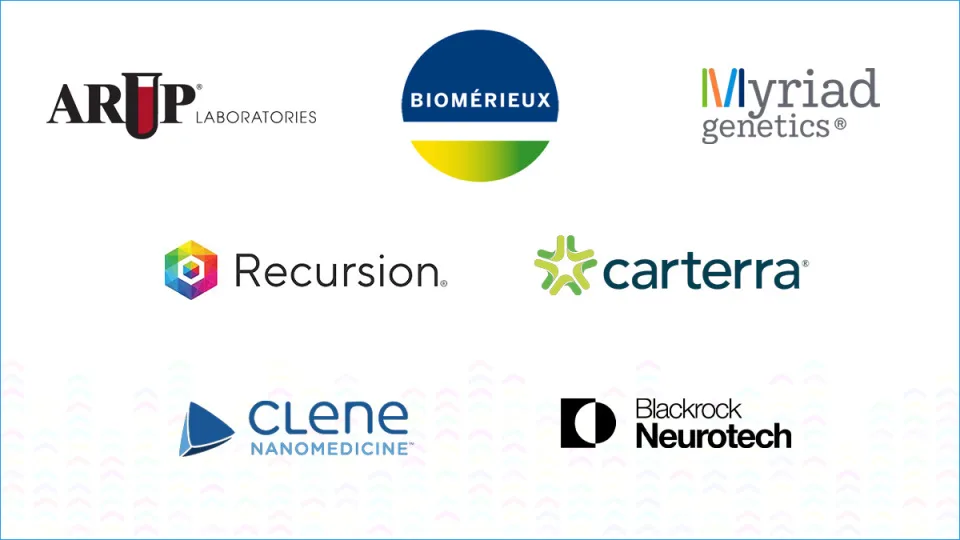
ARUP Laboratories
Sector: Nonprofit clinical and research laboratory that provides specialized, high-quality clinical and anatomic pathology testing
Year Founded: 1984
Origin Story: Lloyd Martin was the University of Utah’s Pathology business manager when he suggested pathologists own a reference lab. In 1984, Dr. Carl Kjeldsberg and Dr. John Matsen made it happen in Salt Lake City as a non-profit enterprise of the University of Utah’s Pathology Department.
Key Leaders: Andy Theurer, CPA, Chief Executive Officer; Tracy I. George, MD, Chief Scientific Officer; Adam Barker, PhD, President and Chief Operations Officer; Jonathan R. Genzen, MD, Chief Medical Officer
Number of Employees: 4,000-5,000
Stage: Receives funding from various sources like federal grants, revenue from its diagnostic testing business, internal grants for its scientists, and investments in other companies like Techcyt
Financial Snapshot: Raised $128.8 million since inception
Notable Investors: Federal grants and partners in its innovation unit such as Cathay Innovation, GE Vernova, and the Rockefeller Foundation
Key Products: Automation lab system that accelerates diagnostic technologies with AI and bioinformatics
Recent Highlights: In March 2025, the company announced advancements in its AI-augmented screening tool for the detection of human gastrointestinal parasites to include wet-mount slides, making them the first lab to apply AI-augmented screening to the entire ova and parasite testing process. In February 2025, ARUP Labs was awarded a Best of BioHive Utah Community Impact Award for serving communities through education, advocacy, and innovation.
bioMérieux
Sector: Molecular diagnostics, in vitro diagnostics for clinical and industrial applications, and tools for infectious disease identification and microbial quality control
Year Founded: bioMérieux was founded in 1963 and acquired BioFire Diagnostics in 2014
Origin Story: In 1897, Marcel Mérieux founded a lab to develop the first anti-tetanus sera. From there his family remained in public health and in 1963 his son Dr. Charles Mérieux and grandson Alain Mérieux started bioMérieux with a focus on in vitro diagnostics.
Key Leaders: Pierre Boulud, CEO of bioMérieux; Randy Rasmussen, CEO/President of BioFire
Number of Employees: ~14,600
Stage: bioMérieux is a public company listed on the Euronext Paris stock exchange (BIM)
Financial Snapshot: Since being acquired by bioMérieux in 2014, BioFire Diagnostics is no longer a venture-funded startup. This acquisition was funded through bioMérieux’s own finances and a bond issue, not a traditional venture capital funding round.
Key Products: BIOFIRE FILMARRAY System, a line of fully integrated, multiplex PCR systems that perform syndromic infectious disease testing
Recent Highlights: In February 2025, bioMérieux received U.S. FDA clearance for the updated version of its BIOFIRE FILMARRAY Gastrointestinal (GI) Panel Mid, which tests for 11 common bacteria, viruses, and parasites in about an hour. In April 2025, the company obtained CE-marking for LUMED APSS, a cutting-edge software solution to aid medical decision-making in Antimicrobial Stewardship.
Myriad Genetics

Sector: Genetic and genomic insights
Year Founded: 1991
Origin Story: Peter Meldrum, Mark Skolnick, PhD, Nobel Laureate Walter Gilbert, and Kevin Kimberlin set out to find genes linked to diseases like breast cancer. They made their mark by isolating the BRCA1 and BRCA2 gene mutations for breast cancer, leading to the first hereditary cancer diagnostic tests. Their patenting of these genes initiated legal battles that impacted gene patent law.
Key Leaders: Sam Raha, President and Chief Executive Officer; Mark Verratti, Chief Operating Officer; Dale Muzzey, PhD, Chief Scientific Officer ; Kevin Haas, Chief Technology Officer
Number of Employees: ~2,700
Stage: Publicly-traded company
Financial Snapshot: In 2025, the company obtained a $200M credit line with OrbiMed to fund its growth and operations in precision medicine.
Key Products: Researchers identified the BRCA1 (1994) and BRCA2 (1995) genes, leading to the BRACAnalysis test for hereditary breast and ovarian cancer.
Recent Highlights: In November 2025, the company added 15 new genes to its MyRisk Hereditary Cancer Test to cover more cancer types recommended by oncology guidelines. That same month, they also launched an AI-driven breast cancer risk platform with Clairity and MagView to identify high-risk women.
Recursion Pharmaceuticals

Sector: Healthcare and biotechnology
Year Founded: 2013
Origin Story: Co-founder Chris Gibson was an MD/PhD student at the University of Utah lab, studying a rare brain blood disease. After almost a decade of research, the team’s hypothesis was tested in a mouse model, but the results showed that treatment they developed made the condition worse. Gibson decided to start a company after a computer outperformed a human biologist when it came to predicting successful drug candidates from a large library of existing drugs.
Key Leaders: Najat Khan, PhD, President and CEO; David Hallett, PhD; Chief Scientific Officer; Ben Mabey, MS, Chief Technology Officer; David Mauro, MD, Chief Medical Officer
Number of Employees: ~800
Stage: Publicly-traded company
Financial Snapshot: As of January 2026 Recursion Pharmaceuticals has a market cap of $2.29 Billion
Key Products: Recursion OS platform that uses a combination of AI, massive biological datasets, and automation to fundamentally change how drugs are discovered and developed
Recent Highlights: In December 2025, the company reported positive phase 1b/2 results from ongoing REC-4881 TUPELO Trial. It showed rapid and durable reductions in polyp burden in familial adenomatous polyposis at 25 Weeks.
Carterra
Sector: Biotech and drug discovery
Year Founded: 2005
Origin Story: Founder Josh Eckman was studying at the University of Utah and was offered a position as research assistant to go through a portfolio of patents and identify key opportunities. When he discovered the patent for a biosensor that uses microfluidic technology to analyze samples much faster than general biosensors, he started the company Wasatch Microfluidics. That company later became Carterra in order to commercialize his technology.
Key Leaders: Josh Eckman, MS, Chief Executive Officer; Tim Germann, Chief Commercial Officer; Steve Chipchase, Chief Production Officer
Number of Employees: 50-100
Stage: Later-stage, series G
Financial Snapshot: The company has raised $37.6 million since inception.
Notable Investors: Ballast Point Ventures; PerkinElmer; Telegraph Hill Partners
Key Products: Fully integrated Surface Plasmon Resonance (SPR) Platforms for drug discovery applications
Recent Highlights: In January 2025, Carterra shipped the first units of its newest biosensor platform, the Carterra Ultra, which allows for high-throughput characterization of both small and large molecules.
Clene
Sector: Biopharmaceuticals and therapeutics
Year Founded: 2013
Origin Story: Physicist and materials scientist Mark Mortenson was inspired by the quantum physics teachings of late professor Rustum Roy at Pennsylvania State University and Hans-Peter Durr, who was the vice executive director of the Max Planck Institute for Theoretical Physics at Heidelberg. Mortenson developed a thesis to create “clean-surfaced” metal nanocrystals for treating neurodegenerative diseases and the company, Clene, emerged from this.
Key Leaders: Rob Etherington, President & CEO; Mark Mortenson, Chief Science Officer; Benjamin Greenberg, MD, Head of Medical
Number of Employees: ~80
Stage: Publicly-traded company
Financial Snapshot: The company’s current market cap is $59.5 million
Key Products: Clean-Surface Nanocrystal (CSN) therapeutics and CNM-Au8, catalytically-active gold nanocrystal suspension developed to restore neuronal health and function by improving mitochondrial function and reducing oxidative stress
Recent Highlights: In December 2025, Clene announced results from FDA-recommended biomarker analyses for its ALS drug CNM-Au8, which showed a significant reduction in neurofilament light (NfL) and GFAP. These biomarkers are strongly associated with improved survival outcomes, reinforcing.
Blackrock Neurotech
Sector: Biotech and neurotechnology (therapeutic devices)
Year Founded: 2008
Origin Story: In 1989, The Utah Array, a microelectrode grid for recording neural signals, was invented at the University of Utah. By 2008, the technology spun out as Bionic Technologies, then Cyberkinetics, which received FDA clearance for early human trials. Then in 2008, Blackrock Microsystems (now Blackrock Neurotech) was founded by Florian Solzbacher and Marcus Gerhardt, after acquiring Cyberkinetics and its Utah Array technology.
Key Leaders: Marcus Gerhardt, Co-Founder and Chief Executive Officer; Florian Solzbacher, PhD, Co-Founder and Chief Scientific Officer
Number of Employees: ~166
Stage: Capital comes from large strategic/private financings
Financial Snapshot: In April 2024, Tether gave $200 million strategic investment, giving it majority ownership. Previously in May 2021, Christian Angermayer and Peter Thiel supported the company’s technology expansion in a $10 million private financing round.
Notable Investors: Tether Evo; Peter Thiel; Christian Angermayer; Mind Capital; Tim Sievers: Sorenson Impact's University Venture Fund II
Key Products: Implantable brain-computer interface (BCI) technology called Utah Array, which allows people with paralysis to control external devices with their thoughts.
Recent Highlights: In August 2024, research using Blackrock’s technology highlighted the development of a BCI system that restored a patient’s voice, translating brain signals into speech with up to 97% accuracy.