




Cure
Overview
From AI-driven drug discovery to next-generation diagnostics, these precision medicine startups are shaping how personalized care reaches patients in 2026.
Precision medicine is reshaping how new therapies are developed and delivered by shifting the focus from population averages to individual patients. By accounting for differences in genetics, biology, environment, and lifestyle, this approach aims to reduce trial and error and improve how quickly patients get to the right treatment. That shift is already showing up in market momentum. Precision medicine generated an estimated $151.57 billion globally in 2024 and is projected to grow to $469 billion by 2034, driven by advances in genomics, data science, and AI-powered clinical tools. More importantly, it’s being pulled forward by frustration on the front lines of care. “There is a growing demand for innovation in precision medicine, which is largely due to the fact that patients and clinicians are fed up with generic, trial-and-error healthcare,” said Lief Hands, Doctor of Chiropractic and Clinic Director at Precise Chiropractic & Rehabilitation.
Hands said patients now expect the same level of accuracy and personalization from healthcare that they see in fields like technology and engineering. “This transition is driving the industry toward tools that forecast disease before it appears, tailor treatments for each patient, and integrate genetics with details about how an individual lives. The next frontier of precision medicine will not just be reading DNA; it will be integrating genetic insights to how we move, age, and recover in real life.”
We've curated a list of precision medicine companies with credible paths to clinical impact and value creation in the coming year.
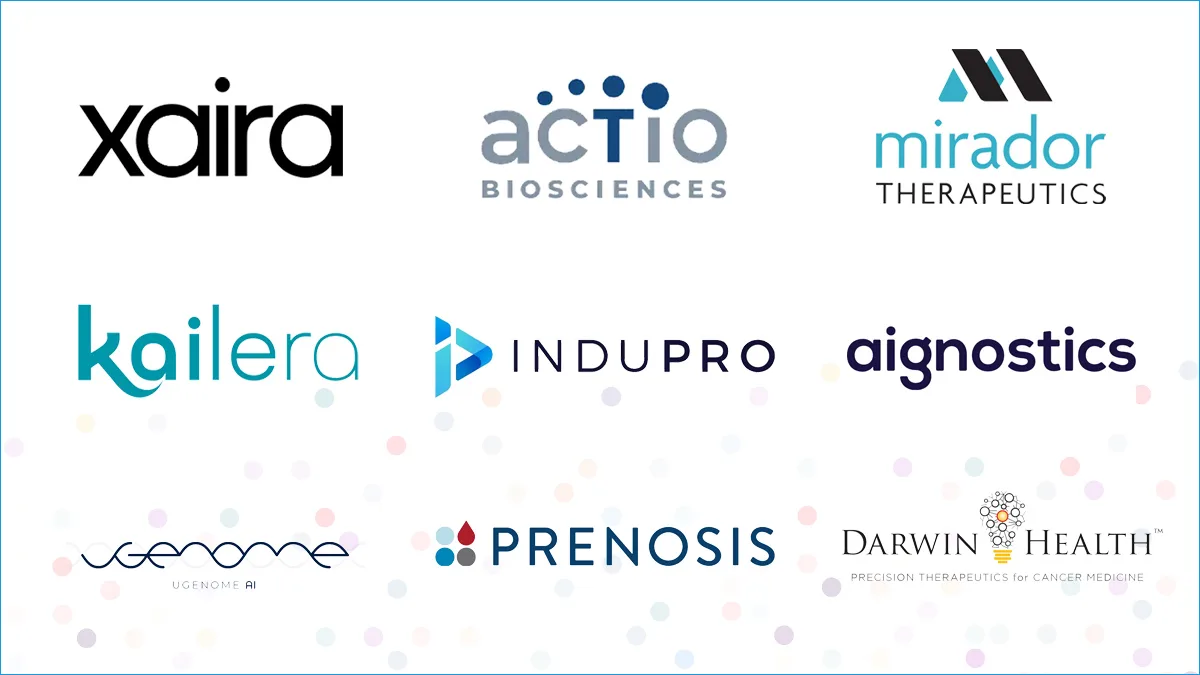
Xaira Therapeutics

Sector: AI drug discovery and development
HQ: San Francisco, CA
Year Founded: 2024
Origin Story: Xaira’s core technology is based on AI models for protein and antibody design that was developed by Nobel Laureate David Baker, PhD, and his team at the University of Washington’s Institute for Protein Design.
Key Leaders: Marc Tessier-Lavigne, PhD, Co-founder, Chairman, and CEO; David Baker, PhD, Co-Founder and Scientific Advisor; Carolyn Bertozzi, PhD, the 2022 Nobel Laureate in Chemistry, Stanford University; Scott Gottlieb, MD, former FDA head; Alex Gorsky, former CEO of Johnson & Johnson
Number of employees: 51-200
Stage: Launch financing (early-stage)
Financial Snapshot: Launched with more than $1 billion in committed funding in April 2024
Notable Investors: ARCH Venture Partners; Foresite Labs
Key Products: AI-Driven Molecular Design such as RFdiffusion and ProteinMPNN developed by David Baker’s lab at the University of Washington is used to design novel proteins and antibodies from scratch, including for previously “undruggable” targets.
Recent Highlights: In June 2025, Xaira released the largest publicly available Perturb-seq dataset, which it named X-Atlas/Orion. Made of eight million cells, it targets all human protein-coding genes, with deep sequencing of over 16,000 unique molecular identifiers (UMIs) per cell. Their innovation is unique in that it detects dose-dependent genetic effects to determine how gene activity changes with the intensity of a given intervention.
Actio Biosciences
Sector: Genetics, drug discovery, and data science to develop small molecule therapeutics for rare and common diseases
HQ: San Diego, CA
Year Founded: 2023
Origin Story: The company launched by working with The Jackson Laboratory to engineer mouse models that better recapitulate diseases, potentially allowing Actio scientists to more accurately vet would-be drugs.
Key Leaders: David Goldstein, PhD, Co-Founder and CEO; David Breckenridge, PhD, Chief Scientific Officer; Samuel Collins, PhD, Chief Medical Officer
Number of Employees: 11-50
Stage: Closed Series B
Financial Snapshot: Closed a $66 million Series B round in June 2025
Notable Investors: Regeneron Ventures; Canaan, Droia Ventures; Euclidean Capital
Key Products: TRPV4 inhibitor (ABS-0871) targets Charcot-Marie-Tooth disease, type 2C (CMT2C) and KCNT1 inhibitor (ABS-1230), which targets KCNT1-related epilepsy
Recent Highlights: In September 2025, Actio Biosciences announced that the first participant was dosed in its Phase 1a healthy volunteer clinical trial of ABS-1230 for the treatment of KCNT1-related epilepsy.
In the company’s press release, David Goldstein, PhD, CEO of Actio, stated, “Advancing ABS-1230 into the clinic marks a historic milestone for Actio and the patients living with KCNT1-related epilepsy, a debilitating and severe epilepsy with no disease-modifying therapies available today. Designed to address the root cause of this devastating disease, ABS-1230 has the potential to offer patients an option that could meaningfully reduce seizures and improve daily quality of life.”
Mirador Therapeutics
Sector: Genetics, data science, and machine learning
HQ: San Diego, CA
Year founded: 2024
Origin Story: When Merck acquired Prometheus Biosciences in 2023, executives from Prometheus decided to start Mirador Therapeutics.
Key Leaders: Mark C. McKenna, Founder, Chairman & CEO; Olivier Laurent, PhD, Chief Scientific Officer; Allison Luo, MD, Chief Medical Officer
Number of Employees: 11-50
Stage: Series A
Financial Snapshot: Raised more than $400 million in a Series A financing in March 2024
Notable Investors: ARCH Venture Partners; OrbiMed; Fairmount Partners; Fidelity Management & Research Company; Sanofi Ventures
Key Products: The company’s Mirador360 platform uses human genetics and data science to identify and validate novel therapeutic targets for GI, lung, and skin conditions.
Recent Highlights: In 2024, the company began a research collaboration with 23andMe that allows Mirador to leverage a targeted set of aggregated, de-identified genetic and phenotypic data from 23andMe’s research database. Mirador will use the database to augment its Mirador360 development engine.
Kailera Therapeutics
Sector: Injectable and oral therapies for the treatment of obesity and type 2 diabetes HQ: Waltham, MA Year Founded: 2024 Origin Story: Kailera Therapeutics was formed to license and advance four potential obesity drugs outside of China that were developed by China’s Jiangsu Hengrui Pharmaceuticals. Key Leaders: Ron Renaud, President and CEO; Scott Wasserman, MD, Chief Medical Officer Number of Employees: ~ 125 Stage: Series B Financial Snapshot: Raised $600 million in Series B in October 2025 Notable Investors: Bain Capital Private Equity; Atlas Venture Key Products: Injectable KAI-9531 (called HRS9531in China) a dual GLP-1/GIP receptor agonist. Positive Phase 2 clinical trial results in China have paved the way for global Phase 3 studies, slated to begin by the end of 2025. Recent Highlights: In November 2025, the company announced new data from Hengrui’s Phase 3 clinical trial1 (GEMINI-1) of Kailera’s once-weekly subcutaneous injection of HRS9531, in individuals living with obesity or overweight in China. A key study finding includes a mean weight loss of 19.2%I at 6 mg with no plateau and favorable safety profile in 48-week Phase 3 clinical trial. Kailera plans to start global Phase 3 program, which the planned to initiate by the end of 2025.
InduPro
Sector: Protein-based therapeutics, primarily bispecific antibodies, for cancer and autoimmune diseases
HQ: Seattle, WA
Year Founded: 2022
Origin Story: Scientists from Merck who invented a protein proximity-based mapping technology that can develop a new class of proximity-based therapeutics for cancer and autoimmune diseases founded the company to use the technology to develop effective treatments.
Key Leaders: Prakash Raman, PhD, CEO; Chris Garcia, PhD; Scott Lesley, PhD, President & CSO; Rob Oslund, PhD; Niyi Fadeyi, PhD
Number of Employees: 11-50
Stage: Series A
Financial Snapshot: Raised $85 million in Series A in June 2024
Notable Investors: The Column Group; Vida Ventures
Key Products: The company’s proximity by design platform develops highly selective therapies, such as bispecific antibody-drug conjugates (ADCs) and T cell engagers (TCEs) that can target cancer cells while minimizing damage to normal tissues.
Recent Highlights: In June 2025, InduPro said its lead program was named a “Top-Ranking Preclinical ADC” by Beacon. The company’s AACR 2025, IDP-001 is a First-in-Class EGFRxCDCP1 Bispecific ADC with Best-In-Class efficacy potential. The therapeutic approach harnesses spatial protein proximity to enable selective targeting of tumor microenvironments through unique co-target pairings. IDP-001 is currently in IND-Enabling studies with IND filing targeted for Q1 2026.
Aignostics
Sector: AI-powered precision diagnostics for pathology
HQ: New York, NY and Berlin, Germany
Year Founded: 2018
Origin Story: Aignostics started at Charité Berlin and the Berlin Institute of Health. With years of research conducted across Charité, TU Berlin, and Fraunhofer HHI, the company spun out of Charité in 2020. Frederick Klauschen, co-founder and lead medical advisor brought on his research from Charité – Universitätsmedizin Berlin.
Key Leaders: Viktor Matyas, MBA, Co-Founder & CEO; Maximilian Alber, PhD, Co-Founder & CTO; Frederick Klauschen, Co-Founder & Lead Medical Advisor
Number of Employees: 51-200
Stage: Series B
Financial Snapshot: Raised $34 million in October 2024 and $14 million in a Series A round in September 2022 and a Seed round in August 2020
Notable Investors: ATHOS; Wellington Partners; High-Tech Gründerfonds (HTGF); Boehringer Ingelheim Venture Fund (BIVF); Mayo Clinic; Ascenion Capital
Key Products: RudolfV and Atlas (developed with Mayo Clinic) foundation models for histopathology designed for accurate and generalizable analysis of tissue images. Atlas H&E-TME Application, a self-service AI-powered application for comprehensive tumor microenvironment profiling in H&E stained images.
Recent Highlights: In October 2025, Aignostics announced the general availability of Atlas H&E-TME, which was co-created by Aignostics, Mayo Clinic, and Charité Berlin. The application analyzes the tumor microenvironment (TME) in H&E images. The company states that the innovation analyzes whole-slide images in hours, enabling researchers to rapidly characterize immune cell populations, spatial relationships, and tissue architecture across multiple cancer types.
In a press release, Viktor Matyas, Co-Founder & CEO of Aignostics said, “Understanding the TME is essential for developing effective cancer therapies, but traditional approaches are costly, time-consuming, and often limited in scale. Atlas H&E-TME changes this paradigm. Our pilots with biopharma have confirmed we can deliver high-quality results with unparalleled accuracy, speed, and scale, helping researchers get maximum value from every H&E image.”
UGenome AI
Sector: Advanced genomic software and bioinformatics tools
HQ: Tucson, AZ
Year Founded: 2022
Origin Story: This is the fourth startup for Zachary S. Brooks, PhD, Founder & CEO.
Key Leaders: Zachary S. Brooks, PhD, Founder & CEO; Jayden Lee, EMBA & PharmD, BCACP, Chief Genomics Officer & Co-Founder; Peter Bannister, DPhil, Chief Strategy Officer & Co-Founder
Number of Employees: 2-10
Stage: Accelerator/incubator stage
Financial Snapshot: Strategic partnerships with PlexusDX, The Beautiful Way, Lincoln Health, Auna, and Clinical Media
Notable Investors: Tech Launch Arizona; CONNECT (San Diego); Anishek Kamal
Key Products: ProPEx, which converts whole genome or exome sequencing data into structured pharmacogenetic reports for precision prescribing and targeted drug–gene analysis. Maxx, which builds individualized reference genomes to improve variant detection in RNA and DNA sequencing for oncology research. Seq4Life, an analysis engine designed for both germline and somatic datasets, with capabilities to produce customizable variant reports and targeted panels.
Recent Highlights: In August 2025, the company announced a partnership with Robust Diagnostics that will allow it to push forward research and development for improved clinical outcomes powered by previous detection biomarkers.
In a press release, Zachary Brooks, PhD, founder and CEO of UGenome AI, said, “UGenome AI’s focus is on helping develop better treatment options and that comes directly from better diagnoses that’s why we are thrilled to partner with Robust Diagnostics who is pioneering antibody binding which is leapfrogging other early detection methods for MS. Combined with UGenome’s use of medication response and bioinformatics platform, Robust Diagnostics and UGenome AI can take a huge step forward for human health.”
Prenosis
Sector: AI for personalized diagnostics and treatments for acute care conditions
HQ: Chicago, IL
Year Founded: 2014
Origin Story: Bobby Reddy Jr., PhD, and Rashid Bashir, PhD, founded the company from research and technology they developed in the Micro and Nanotechnology Laboratory at the University of Illinois Urbana-Champaign.
Key Leaders: Bobby Reddy Jr., PhD, CEO & Founder; Carlos Lopez-Espina, SVP of Research & Development
Number of Employees: ~ 50
Stage: Combination of venture capital and significant grant awards
Financial Snapshot: Raised over $20 million with venture funding in 2022
Notable Investors: PACE Healthcare Capital; two grants from The National Institutes of Health (NIH) totaling $4.8 million awarded in 2023
Key Products: Sepsis ImmunoScore, the first FDA-authorized AI/ML tool for sepsis risk diagnosis and prediction
Recent Highlights: In June 2025, Sepsis ImmunoScore was named Honoree in Fast Company’s 2025 World Changing Ideas Awards.
DarwinHealth
Sector: Precision-focused cancer medicine platform
HQ: New York, NY
Year Founded: 2015
Origin Story: Founded by Andrea Califano and Gideon Bosker who met in 2013. The company’s technology is based on algorithms developed in the Califano Lab at Columbia University and licensed exclusively to DarwinHealth.
Key Leaders: Gideon Bosker, Co-founder & CEO; Andrea Califano, Co-founder & Chief Scientific Advisor; Mariano Alvarez, Chief Scientific Officer; Stuart Andrews, Chief Data Sciences Technology Officer
Number of Employees: 11-50
Stage: Early-stage private
Financial Snapshot: University and accelerator
Ecosystem Support: Columbia University and NYC biotech incubator Audubon Biomedical Center
Key Products: Systems biology platform that uses its VIPER algorithm to identify “tumor checkpoints” or master regulator proteins that drive cancer.
Recent highlights: In March 2025, the company was named one of Fast Company’s 2025 Most Innovative Companies for its research. Trial results published in 2024 showed 100% accuracy of DarwinOncoTarget at predicting response to HDAC6 inhibitors in breast cancer.