
Cure.
Overview
Researchers are testing new ways to help people communicate, regain movement after a stroke, and recover some vision. See which devices are still in trials and which have reached the market.
A promising brain-computer interface demonstration can involve one patient, a specialized lab, and weeks of tuning by an engineering team. For developers, the next test is whether the device can work across patients and fit into routine care.
“Technology that’s ready for routine care has to work across patients without being rebuilt for each one, and it needs to fit into clinical workflows, with training and support that hospitals can realistically provide,” said Samuel Browd, MD, a pediatric neurosurgeon and co-founder and CEO of Oaya.
For Browd, access to responsibly shared neural data is a bigger barrier to progress than manufacturing at scale or reimbursement. When teams have to build their own datasets, it is harder to test how a system performs across patients and care settings. Sharing those recordings raises questions about who can use them, what patients consented to, and how the data are protected. It also takes staff time that may go unfunded, Browd said.
Wider use will also depend on whether hospitals have enough neurosurgeons to implant the devices and care teams to handle programming, rehabilitation, and follow-up. Less-invasive and noninvasive devices could reduce some of those demands where they can deliver the benefit a patient needs. Browd also sees room for software to extract more information from existing recordings, potentially reducing the need for additional implanted electrodes.
The FDA has issued guidance on testing and study design for implanted brain-computer interfaces in people with paralysis or amputation. Longer follow-up can show whether an implant still does what a patient needs years after surgery.
“For implanted systems, early results may not fully capture the effects of scar tissue, signal changes over months, hardware wear, or power and heat constraints,” Browd said.
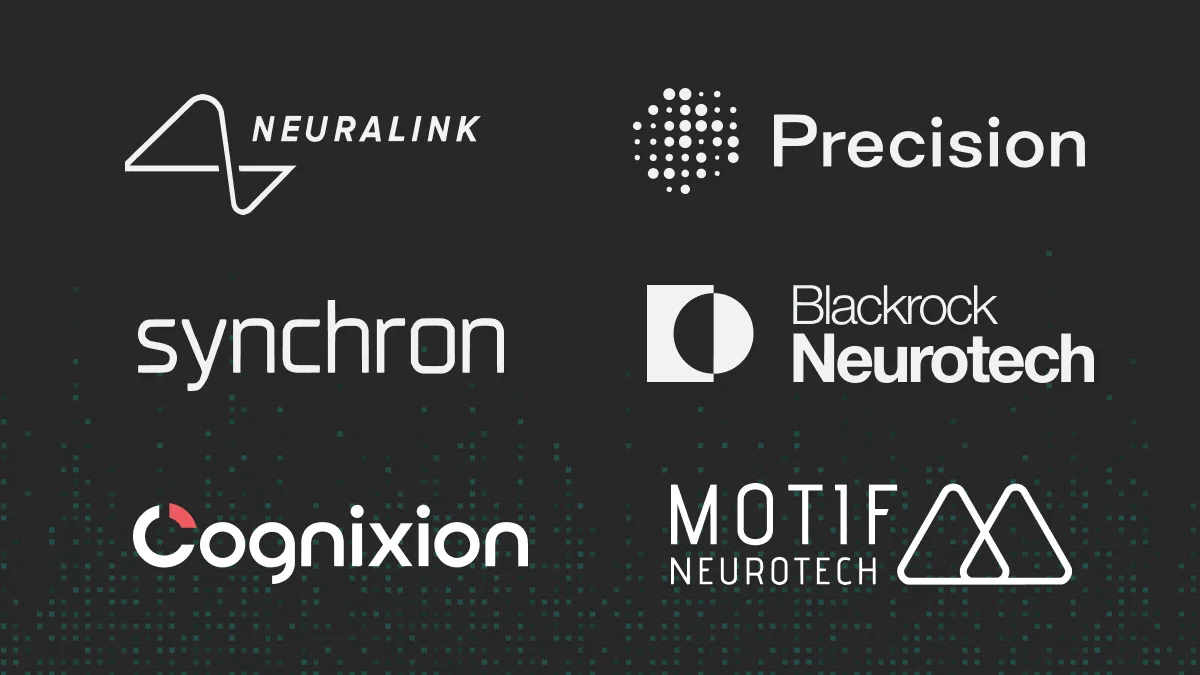
The 10 companies below span implanted and wearable interfaces and related neurotechnology. Their profiles show what each device is designed to do, what has been tested in people, and which products have reached the market.
Neuralink
Sector: Implantable brain-computer interface (BCI) for paralysis, with speech and vision programs
HQ: Austin, TX
Year Founded: 2016
Key Leaders: Elon Musk is co-founder
Number of Employees: 201-500
Stage: Private, Series E
Financial Snapshot: $650M round announced June 2, 2025, reported at a $9B pre-money valuation
Notable Investors: ARK Invest, DFJ Growth, Founders Fund, G42, Human Capital, Lightspeed, QIA, Sequoia, Thrive, and Valor, Vy Capital
Key Products: Telepathy (N1 implant) for computer control. Other potential products include a speech trial called VOICE and Blindsight (vision).
Implanted vs. Noninvasive: Implanted
Regulatory Status: Breakthrough Device designation for Blindsight in September 2024 and for the speech device in 2025. Neither has FDA approval.
Number of Patients Implanted: 21 per the company’s January 28, 2026 report.
Recent Highlights: Neuralink told the public in January 2026 that 21 people had been implanted worldwide, and it launched a new trial called VOICE aimed at restoring speech. Elon Musk has said the company will move to high-volume production and a nearly fully automated surgical procedure in 2026. Blindsight, its vision program, is still waiting on its first human implant.
Synchron
Sector: Endovascular (stent-based) BCI for paralysis
HQ: Brooklyn, NY, with expansion in San Diego
Year Founded: 2016
Key Leaders: Tom Oxley, MM, is CEO and founder
Number of Employees: 51-200
Stage: Private, Series D
Financial Snapshot: $200M Series D in November 2025, bringing total funding to $345M. Valuation is about $1B.
Notable Investors: Double Point Ventures (lead), Australia’s National Reconstruction Fund, T.Rx Capital, Qatar Investment Authority, K5 Global, Protocol Labs, and IQT
Key Products: Stentrode, plus a next-generation transcatheter high-channel interface that gets about 20% of the Series D
Implanted vs. Noninvasive: Implanted but non-surgical (delivered through a blood vessel)
Regulatory Status: Breakthrough designation in August 2020. COMMAND was the first IDE trial of a permanently implanted BCI in the U.S. and met its primary safety endpoint. Not yet approved, and a pivotal trial is still needed.
Number of Patients Implanted: 10 across the U.S. and Australia
Recent Highlights: Synchron raised a $200 million Series D in November 2025 at a valuation of about $1 billion, money meant to carry its Stentrode toward a pivotal trial and commercial launch. The device rests on the COMMAND study, the first FDA-approved trial of a permanently implanted BCI, which met its primary safety goal. In November 2026, however, enrollment was paused after a problem with the cable that carries signals from the implant.
Paradromics

Sector: Implantable high-bandwidth BCI for speech restoration and computer control
HQ: Austin, TX
Year Founded: 2015
Key Leaders: Matt Angle, PhD, founder and CEO; Stephen Ryu, MD, Chief Medical Officer; and William J. Marks, Jr., MD, MS-HCM, Chief Clinical Officer as of July 2026.
Number of Employees: 51–200
Stage: Private, growth stage
Financial Snapshot:$33M Series A in May 2023, led by Prime Movers Lab. Total funding is $105M to $121M across equity, notes, and federal grants.
Notable Investors: Prime Movers Lab, Westcott Investment Group, Dolby Family Ventures, Green Sands Equity, NEOM Investment Fund, 15th Rock Ventures, Yamauchi-No.10 Family Office, and Alpha Edison
Key Products: Connexus BCI, wireless and fully implantable, with 421 microelectrodes
Implanted vs. Noninvasive: Implanted
Regulatory Status: The FDA authorized an early feasibility study for Paradromics’ Connect-One study in November 2025, billed as the first IDE for speech restoration with a fully implantable BCI. Breakthrough designation in 2023.
Number of Patients Implanted: 1 long-term participant. Connect-One initially enrolled two.
Recent Highlights: The FDA authorized an early feasibility study for Paradromics’ Connect-One in November 2025, the first IDE for speech restoration with a fully implantable BCI. In June 2026, surgeons at University of Michigan Health performed the first implant in a woman with motor neuron disease. By September, she was choosing her own words and speaking in real time, including on a call with her grandchildren.
Precision Neuroscience
Sector: Minimally invasive thin-film cortical-surface BCI
HQ: New York, NY
Year Founded: 2021
Key Leaders: Michael Mager, CEO and Co-Founder; Ben Rapoport, MD, Co-Founder and Chief Science Officer; Craig Mermel, President and Chief Product Officer.
Number of Employees:51-200
Stage: Private, Series D
Financial Snapshot: $250M Series D in 2026. It follows a $102M Series C in December 2024. The $250M round brings total capital raised to approximately $430 million.
Notable Investors: General Equity Holdings (Series C lead), B Capital, Duquesne Family Office, Steadview Capital, SCI Ventures, Pershing Square, Ackman Oxman Institute, Duquesne Family Office, ARK Invest, Invus, Mubadala Capital, Mirae Asset Capital, Korea Investment Partners, Hitachi Ventures, and JSL Health Capital.
Key Products: Layer 7 Cortical Interface is a thin-film array with 1,024 electrodes and the Medtronic partnership is to integrate Layer 7 with Medtronic's StealthStation surgical navigation platform.
Implanted vs. Noninvasive: Minimally invasive implant on the brain’s surface.
Regulatory Status: 510(k) clearance announced April 2025, authorizing commercial use for up to 30 days of implantation. A permanent BCI is not yet cleared.
Number of Patients Implanted: More than 100 implanted clinical study patients
Recent Highlights: Precision became the first of the new wave of BCI developers to win commercial clearance when the FDA cleared its Layer 7 array in April 2025 for up to 30 days of use. A paper in Nature Biomedical Engineering described its first five patients, in whom the system detected attempted speech with nearly 80% accuracy. This accuracy was obtained under specific experimental conditions.
Blackrock Neurotech
Sector: Intracortical electrode arrays and BCI systems for research and clinical use
HQ: Salt Lake City, UT
Year Founded: 2008
Key Leaders: Marcus Gerhardt, Co-Founder and CEO; Florian Solzbacher, Co-Founder and CSO
Number of Employees: 51-200
Stage: Private; Tether has majority stake
Financial Snapshot: Tether invested $200M, mainly to fund commercialization and rollout
Notable Investors: Tether; re.Mind Capital took part in an earlier $10M round in 2021
Key Products: The Utah Array, a widely used intracortical electrode, has a 4 × 4 mm footprint and typically 96 penetrating microelectrodes. The company offers different configurations and says multiple arrays can be combined for up to 1,024 channels.
Implanted vs. Noninvasive: Implanted
Regulatory Status: The array is already FDA-cleared and used in humans for research and temporary use rather than a chronic clinical BCI approval.
Number of Patients Implanted: Per Tether’s CEO more than 40
Recent Highlights: Tether made a $200 million strategic investment in April 2024 to fund commercialization of Blackrock’s technology. Its Utah Array sits behind some of the field’s best-known results: UC Davis researchers used Blackrock arrays to restore speech to a patient with ALS with 97% accuracy.
Motif Neurotech
Sector: Minimally invasive neurostimulation implant for treatment-resistant depression
HQ: Houston, TX
Year Founded: 2022
Key Leaders: Jacob Robinson is CEO and founder
Number of Employees: 11-50
Stage: Private, Series A
Financial Snapshot: $18.75M oversubscribed Series A, led by Arboretum Ventures in January 2024
Notable Investors: Arboretum Ventures, KdT Ventures, Satori Neuro, Dolby Family Ventures, re.Mind Capital, Max Hodak, Divergent Capital, TMC Innovation, PsyMed Ventures, Empath Ventures, and Capital Factory
Key Products: The XCS System and its DOT implant, roughly pea-sized and embedded in the skull; wireless, battery-free, placed in a short outpatient procedure
Implanted vs. Noninvasive: Implanted in the skull, not touching the brain surface
Regulatory Status: FDA IDE for the RESONATE early feasibility study in 2026 and Breakthrough Device designation for XCS
Number of Patients Implanted: No chronic implants reported. A proof-of-concept first-in-human implant was completed in 2023.
Recent Highlights: Motif has gone from a pea-sized prototype stimulator tested on its first human patient in 2023 to FDA authorization to begin a clinical trial in 2026 forRESONATE, its first trial of an implant for treatment-resistant depression. The FDA also granted the system Breakthrough Device designation, and in April 2026 Motif announced a collaboration with London-based MintNeuro on low-power chips for neural implants.
Kandu
Sector: Noninvasive (EEG-based) BCI plus telehealth for stroke recovery
HQ: Los Angeles, CA
Year Founded: 2022
Key Leaders: Leo Petrossian is CEO and Eric Leuthardt, M.D., is Chief Scientific Officer
Number of Employees: 51-200
Stage: Private, commercial-stage
Financial Snapshot: $30M financing in April 2025
Notable Investors: Ally Bridge Group and AMED Ventures
Key Products: IpsiHand, a noninvasive at-home BCI for stroke survivors, plus telehealth stroke services. It includes an EEG headset, a powered handpiece that assists movement, and a microprocessor control unit with therapy software. It detects brain activity associated with the intention to move the affected hand and uses that signal to activate the handpiece
Implanted vs. Noninvasive: Noninvasive (EEG headset)
Regulatory Status: IpsiHand received FDA De Novo marketing authorization on April 23, 2021. It is described by the company as the first and only FDA-authorized BCI therapy for upper-extremity rehabilitation after stroke.
Number of Patients Implanted: Not applicable—noninvasive system
Recent Highlights: Kandu was created in April 2025 when Neurolutions and Kandu Health merged, pairing the FDA-cleared IpsiHand stroke-rehab headset with at-home clinical support, backed by a $30 million financing. The company then published the NIH-sponsored BCI-REHAB trial, which reported no serious or device-related adverse events.
Cognixion
Sector: Noninvasive BCI, augmented reality and AI for communication
HQ: Santa Barbara, CA
Year Founded: 2014
Key Leaders: Andreas Forsland, CEO; Chris Ullrich, CTO
Number of Employees: 11-50
Stage: Private, venture-backed
Financial Snapshot: About $25M raised
Notable Investors: Prime Movers Lab and Amazon Alexa Fund
Key Products: Axon-R is a research-use platform combining EEG, AR, and AI-assisted communication. Apple Vision Pro integration was also evaluated in a separate clinical study.
Implanted vs. Noninvasive: Noninvasive
Regulatory Status: ONE Axon has FDA Breakthrough designation; the research version, Axon-R, is not FDA-cleared as a medical device
Number of Patients Implanted: N/A. The ALS study enrolls up to 10 participants.
Recent Highlights: Cognixion launched its ALS clinical study in January 2025, partially funded by ALS Accel. It subsequently announced an Apple Vision Pro clinical study. In November 2026, the company announced enrollment in its NIH-funded CHOICE study, which plans to enroll 30 adults with ALS and compare its wearable BCI communication system with existing eye-tracking devices.
Cortigent
Sector: Visual cortical prosthesis for blindness, plus a stroke-motor-recovery device in development
HQ: Santa Clarita, CA
Year Founded:2022
Key Leaders: Jonathan Adams, MBA, CEO; Jerry Culp, CTO; John Bowers, MBA, Director; Uday Patel, PhD, Lead Neuroscientist.
Number of Employees: 2-10
Stage: Wholly owned subsidiary of Vivani Medical
Financial Snapshot: In July 2026, Vivani agreed to a reverse merger combining its subsidiary, Cortigent, with Nasdaq-listed ClearOne, giving Vivani roughly 59.4–67.5% of the combined company. ClearOne's filings flagged going-concern doubt following its 2025 asset sale and a Nasdaq equity deficiency.
Notable Investors: Vivani Medical, which is its parent company
Key Products: Orion is an investigational visual cortical prosthesis featuring a 60-electrode cortical surface array. It’s also developing a neurostimulation system intended to improve arm and hand movement following stroke-related paralysis.
Implanted vs. Noninvasive: Implanted, on the surface of the visual cortex
Regulatory Status: FDA Breakthrough designation; completed a six-year early feasibility study. A pivotal trial is planned, subject to FDA discussions.
Number of Patients Implanted: Six, implanted between January 2018 and January 2019
Recent Highlights: In January 2026, Cortigent presented six-year results from its Orion visual prosthesis study. All six implanted subjects did better with the system on than off, and the company is now planning a larger pivotal trial.
Science Corp.

Sector: Retinal BCI for vision restoration
HQ: Alameda, CA
Year Founded: 2021
Key Leaders: Max Hodak, Co-Founder and CEO; Darius Shahida, President; Alan Mardinly, PhD, Co-Founder and CSO; Emma Zhou, Co-Founder and DIrector of BCI Research; Frank Brodie, MD, CMO
Number of Employees:51-200
Stage: Private, venture-backed, with a Series D completed in November 2026.
Financial Snapshot: The company had a $230 million Series C in March 2026, which brought total funding to approximately $490 million. Then, in November 2026 the company raised another $400 million in Series D funding, bringing total capital raised to more than $900 million.
Notable Investors: Lightspeed, Khosla Ventures, Y Combinator, IQT, Quiet Capital, Ackman Oxman Institute, Tenet Healthcare, 885 Capital, and PLC Neurotech
Key Products: PRIMA is a subretinal photovoltaic implant paired with specialized glasses
Implanted vs. Noninvasive: Implanted, under the retina
Regulatory Status: CE mark, authorizing commercial availability in 30 European countries. FDA Breakthrough and Humanitarian Use Device designations; still investigational in the U.S.
Number of Patients Implanted: 38 patients received PRIMA implants in the pivotal PRIMAvera clinical trial. Thirty-two completed the 12-month assessment.
Recent Highlights: In July 2026 PRIMA received a CE mark, making it the first BCI device cleared for restoring form vision, including reading letters and words. In October, the company followed up with 36-month trial results showing durable vision restoration.